Friday, December 17, 2021

Commentary: All I want this Christmas is an end to eco-friendly gifts

Metal straws or bamboo cutlery don’t move the needle on the waste problem, says CNA’s Erin Low.

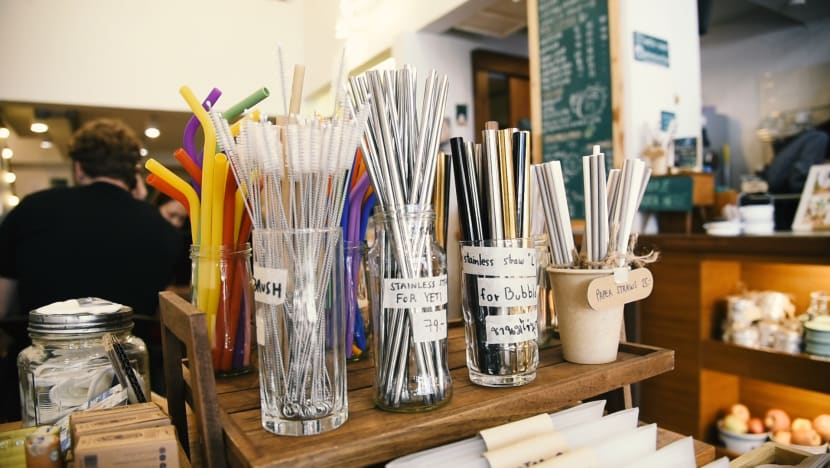
Reusable straws at a bulk store. (Photo: Pichayada Promchertchoo)

Erin Low

17 Dec 2021 


SINGAPORE: Shopping for Christmas gifts? Please take my advice: Do not buy reusable straws. Or anything reusable, really.

My kitchen cabinets are spilling over with sustainable stuff: Glass tupperware, beeswax wraps, grocery bags and more.

Of metal straws, I have a silver one, a chrome blue one, a multicoloured one, and a golden one with a crook on top so it looks like a bendy straw – but because it can't actually bend, it always catches on my drawer whenever someone opens it.

To add to the clutter, each straw comes with a thin brush that can be slipped in to clean the inside. They resemble tiny toilet brushes but serve no other purpose.

Monday, December 13, 2021

Taiwan says it is confident Chinese invasion would be very hard

Pilot and navy officers pose in front of an F-16V fighter at the commission of the first squadron of the upgraded
F-16V fighters in Chiayi Air Force Base, Chiayi, Taiwan, Nov 18, 2021. (File photo: REUTERS/Ann Wang)


13 Dec 2021


TAIPEI: A full Chinese invasion of Taiwan with troops landed and ports and airports seized would be very difficult to achieve due to problems China would have in landing and supplying troops, Taiwan's Defence Ministry said in its latest threat assessment.

Wednesday, December 8, 2021

Commentary: China's economy is faltering. The world just doesn't know it yet

As China's run of constant exponential economic growth hints at coming to an end, Morgan Stanley's Ruchir Sharma explains why its effect on the global economy will be underwhelming.


Ruchir Sharma

08 Dec 2021


NEW YORK CITY: China’s surprisingly rapid slowdown is eliciting familiar warnings that, as China goes, so goes the global economy. Only China may not matter as much as it once did.

Sunday, December 5, 2021

Where does the truth lie? Comparing the accounts of Raeesah Khan and WP chief Pritam Singh

By DARYL CHOO

DECEMBER 04, 2021

  • A special report by Parliament’s privileges committee on Dec 3 revealed what transpired in the run-up to former Workers’ Party MP Raeesah Khan’s resignation 
  • This was over a lie she made in Parliament on Aug 3
  • In several areas, however, Ms Khan's account to the commitee differed from assertions made by WP chief Pritam Singh at a press conference on Dec 2

SINGAPORE — New revelations emerged late on Friday (Dec 3) in a special report by Parliament’s Committee of Privileges that shone a light on what transpired in the run-up to former Workers’ Party (WP) Member of Parliament Raeesah Khan’s resignation over a lie she made in the House.

The report, presented to Parliament on the same day, set out Ms Raeesah’s testimony that WP’s leaders had told her to stick to the lie she made during a sitting of Parliament on Aug 3.

Testifying under oath before the committee on Thursday and Friday, Ms Raeesah said that she was told by WP chief Pritam Singh, chairman Sylvia Lim and vice-chairman Faisal Manap that if she and the party could get away with it, there was no need to clarify the lie.

In several areas, her account differed from assertions made by Mr Singh at a press conference on Thursday — raising fresh questions over what led Ms Raeesah to persist with the lie before she made her confession to Parliament on Nov 1.

Former Workers' Party (WP) Member of Parliament Raeesah Khan (left) testifying before Parliament's Committee of Privileges on Dec 2, 2021. WP chief Pritam Singh (right) speaking at a press conference on the same day.

Here is a comparison of their accounts, based on what Mr Singh said at the press conference and what Ms Raeesah told the committee:
Thursday, November 18, 2021

Commentary: Singapore’s plans to import clean electricity could meet resistance abroad

Importing electricity helps Singapore meet energy needs and climate goals, but such plans are contingent on benign political conditions within exporting countries, say researchers.

Quah Say Jye

Kevin Chen

29 Oct 2021 


SINGAPORE: As COP26 approaches, Singapore has made several announcements regarding plans to decarbonise its energy sector.

Chief among them is its plan to import 30 per cent of its electricity from low-carbon or renewable sources by 2035.

Amid the global energy crunch and disruptions to the local electricity retail market, Singapore’s plans to diversify its energy sources are a welcome development.

However, purchasing electricity overseas exposes Singapore to the internal political dynamics of its partners.

Importing electricity is not simply a convenience for Singapore, but a necessary measure to meet its electricity needs and climate goals.

Around 95 per cent of Singapore’s electricity supply is dependent on imports of natural gas.

Plans to indigenously produce renewable energy through rooftop and floating solar installations are important steps but would at best fulfil 4 per cent of the island’s electricity needs by 2030.


3D-printed steaks are now being served at restaurants across Europe

Redefine Meat, an Israeli fake meat startup, plans to expand beyond these 30+ restaurants, and eventually into grocery stores.

NOVEMBER 17, 2021

DAN MCCARTHY

EMERGING TECH EDITOR


Frankly, we don’t talk often enough about the versatility of 3D printers: They can produce mechanical parts, figurines, housing developments, and...also…steak.

Saturday, November 13, 2021

7 reasons global transport is so hard to decarbonise

By CHRISTIAN BRAND

NOVEMBER 12, 2021


Even if current and committed emission policies were to succeed, transport’s carbon emissions would still grow almost 20 per cent by 2050.


Transport accounts for 21 per cent of global carbon emissions.

It is now the largest emitting sector in many developed countries. While Europe and North America dominate historic transport emissions, much of the projected growth in emissions is in Asia.

Even if current and committed policies were to succeed, transport’s carbon emissions would still grow almost 20 per cent by 2050.

Highly ambitious policies could cut these emissions by 70 per cent — but not to zero.

Here are seven reasons global transport is particularly hard to decarbonise.\