February 29, 2016
SINGAPORE — When Mr Ahmad Zahid Hamidi said Malaysia needed migrant workers because local youth shunned manual labour, Zul could only shake his head in disbelief.
Every day, the young graduate crosses the gridlocked Causeway from Johor Baru to Singapore to do exactly the kind of work migrant labourers do in Malaysia – dirty, dangerous and difficult, also known as “3D”.
Zul, 22, has been doing it for three years for one sole reason, the higher salary.
“I earn way more than I ever did in Malaysia. Even though the work is tough, the salary makes up for it,” Zul told The Malaysian Insider recently.
“It’s not true that Malaysians are unwilling to do 3D work. Otherwise, why do you find so many Malaysians in Singapore and Australia looking for such jobs? It’s because the pay in Malaysia is not enough.”
The Malaysian Insider previously reported that more than 400,000 Malaysians work in Singapore as of 2012, the majority of them in blue-collar jobs.
Some, like Zul, forked out about RM2,000 (S$668) to apply for a legal permit and for other paperwork needed to hold a job legally in the Republic.
Monday, February 29, 2016

Sunday, February 28, 2016
Family of 7 live on $1,300 a month
Janice Tai
Some people call sole breadwinners like Mr Ong Leong Hock the "sandwiched class" because they have young children to take care of and elderly parents to support.
But Mr Ong, 49, is literally sandwiched between his wife and three daughters on two beds joined together in a room every night. His family of five would squeeze in a room because the other room in their three-room flat is occupied by his parents.
Though he promised his wife when they got married 13 years ago that they would get a place of their own, it has yet to materialise because finances are tight.
"I have applied for a two-room rental flat nearby because the kids are growing and need their own space and my parents can rent out the room for some income," says Mr Ong in Mandarin. His three daughters are aged four, 12 and 13.
To make ends meet, Mr Ong puts in long hours as a cooked food stall assistant. He starts work at the economical rice stall at the nearby Kovan Hougang market and food centre just after 7am and knocks off at nearly 9pm on weekdays.
Singapore’s economic miracle uncovered
[Note the date of this article. This was published just after LKY's passing in 2015. It is not a new article.]
Ferdinando Giugliano
Mar 24 2015
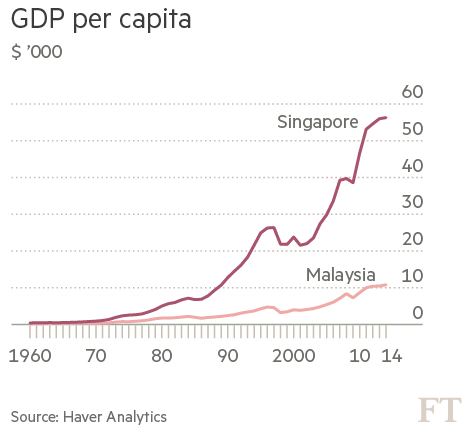
The death of Lee Kuan Yew, the founding father of modern Singapore, has focused attention on the economic miracle he helped to create.
In the three decades since Lee first became prime minister in 1959 until he stepped aside in 1990, per capita income in the city-state rose by a factor of 29, jumping from around $435 to more than $12,700. Nearby Malaysia only managed a ten-fold increase, from $230 to around $2400.
Yet economists remain divided over the causes behind this remarkable take-off.
For some it was the result of inspiration – the ability to import the best technologies from around the world thanks to an enlightened economic model. For others, it was the consequence of perspiration – the sheer accumulation of factors of production such as labour and capital, accompanied by little technological growth.
Thursday, February 25, 2016
Punishing NS dodgers: What's fair, what's not?
Jermyn Chow
Defence Correspondent
25 Feb 2016
Clarity needed on sentencing guidelines for defaulters with little connection to S'pore
In 2006, I was in Parliament listening to then-defence minister Teo Chee Hean painstakingly explain the nation's uncompromising stance against National Service (NS) evaders.
His speech had come in the wake of a public furore over a $3,000 fine handed to celebrity pianist Melvyn Tan for defaulting on his NS for more than three decades. Mr Teo pushed for stiffer fines and jail sentences for those who skip NS.
Since then, this no-nonsense stance has not wavered.
Defence Correspondent
25 Feb 2016
Clarity needed on sentencing guidelines for defaulters with little connection to S'pore
In 2006, I was in Parliament listening to then-defence minister Teo Chee Hean painstakingly explain the nation's uncompromising stance against National Service (NS) evaders.
His speech had come in the wake of a public furore over a $3,000 fine handed to celebrity pianist Melvyn Tan for defaulting on his NS for more than three decades. Mr Teo pushed for stiffer fines and jail sentences for those who skip NS.
Since then, this no-nonsense stance has not wavered.
What you need to know about South China Sea disputes
24 Feb 2016
The South China Sea, dotted with small islands, reefs and shoals, is one of the most hotly contested areas in the world.
While unexplored, much of the disputed area around the Spratly Islands and Paracel Islands is believed to be potentially rich in oil and other natural resources. The sea is also a major shipping route through which over US$5 trillion (S$7 trillion) of maritime trade passes each year.
Here's a quick look at the disputes:
Who claims what?
China: It claims almost all of the resource-rich waters in the South China Sea - an area defined by its "nine-dash line" which extends hundreds of kilometres south from China's Hainan Island to waters off the coast of Borneo, taking in some of the world's busiest shipping lanes.
Beijing says its right to the area goes back centuries to when the Paracel and Spratly island chains were regarded as integral parts of the Chinese nation. In 1947, it issued a map detailing its claims. It showed the two island groups falling entirely within its territory.
Monday, February 22, 2016
Re-opening The X-Files
Ignatius Low
Managing Editor
FEB 21, 2016,
The conspiracy theories in the cult TV series opened my mind to the possibility that neither science nor religion had the answers to everything
Of all the little surprises that came along with the new year, there was none more pleasant than the return of the cult television series, The X-Files.
Yes, the small basement office filled with files on paranormal activity has been reopened. FBI agents Fox Mulder and Dana Scully are back in their jobs investigating these cases and linking some of them to a grand conspiracy theory involving the United States government and alien activity.
I watched with bated breath as the opening episode of the 10th season aired about a month ago, more than 13 years after a two-hour finale in May 2002 was supposed to have "explained everything" and ended the long-running series for good.
My face may not have shown it, but a huge cheer erupted in my heart when Mark Snow's iconic instrumental theme boomed out from the TV set that I had turned up way too loud, together with the original title sequence which had been left entirely intact.
I had, after all, felt much the same way when it boomed out of my tiny Nokia phone speakers - being my very first ringtone purchase all those years ago.
Managing Editor
FEB 21, 2016,
The conspiracy theories in the cult TV series opened my mind to the possibility that neither science nor religion had the answers to everything
Of all the little surprises that came along with the new year, there was none more pleasant than the return of the cult television series, The X-Files.
Yes, the small basement office filled with files on paranormal activity has been reopened. FBI agents Fox Mulder and Dana Scully are back in their jobs investigating these cases and linking some of them to a grand conspiracy theory involving the United States government and alien activity.
I watched with bated breath as the opening episode of the 10th season aired about a month ago, more than 13 years after a two-hour finale in May 2002 was supposed to have "explained everything" and ended the long-running series for good.
My face may not have shown it, but a huge cheer erupted in my heart when Mark Snow's iconic instrumental theme boomed out from the TV set that I had turned up way too loud, together with the original title sequence which had been left entirely intact.
I had, after all, felt much the same way when it boomed out of my tiny Nokia phone speakers - being my very first ringtone purchase all those years ago.
Sunday, February 21, 2016
'Sister, how could you love me after what I have done?'
Sister Gerard Fernandez became a Changi Prison death row counsellor after one of her former students, Catherine Tan Mui Choo, was sentenced to hang with her husband Adrian Lim and his mistress Hoe Kah Hong for the killing of two children in the sensational "ritual murders" case of 1981. The Catholic nun, 78, spoke to Alan John for the 2016 reprint of his book Unholy Trinity.
Alan John
When two children were murdered within a fortnight in Toa Payoh in early 1981, all of Singapore was shocked. But the tragedy hit home especially among the Good Shepherd sisters, a community of Roman Catholic nuns who run schools, a vocational centre for girls and a shelter for women.
They knew the first victim, nine-year-old Agnes Ng Siew Heok, whose family were devout Catholics. And when the police arrested three people for killing Agnes and Ghazali Marzuki, 10, the sisters were distressed to learn that one of the suspects was Tan Mui Choo, who had attended their Marymount Vocational Centre and whom they knew as Catherine.
Said Sister Gerard Fernandez: "I knew Catherine, she was one of our girls. She came from a Catholic family, her parents were very religious, and we knew them too." She was aware that the 26-year-old had fallen into bad company after leaving the vocational centre.
As the sensational case unfolded before the courts, she heard the terrible details, including how Catherine's younger sister and brother had also been tricked by her husband, self-styled spirit medium Adrian Lim, 39.
When Adrian, Catherine and Adrian's 25-year-old mistress Hoe Kah Hong were sentenced to hang on May 23 1983, Sister Gerard felt she had to act quickly: "I thought they were all going to hang the very next day!"
Subscribe to:
Posts (Atom)