Showing posts with label Bureaucracy. Show all posts

Monday, July 14, 2025

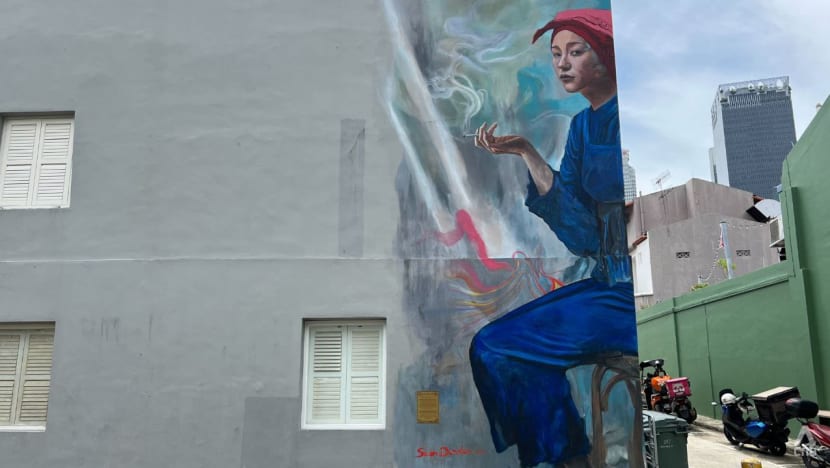
Plaque containing anti-smoking message installed at smoking samsui woman mural

Part of the plaque reads: "Smoking has been shown to be extremely harmful to one's health."

A plaque was installed at the mural of a samsui woman smoking a cigarette. (Photo: CNA)

Ng Hong Siang
Rachel Lim

11 Jul 2025 


SINGAPORE: A plaque bearing an anti-smoking message has been installed at the site of the smoking samsui woman mural in Chinatown, which garnered debate last year.

Saturday, July 2, 2022

The Big Read in short: Where did it all go wrong with the Sports Hub?

Illustration: Anam Musta'ein

In separate interviews with TODAY, former staff of Sports Hub Pte Ltd spoke about deep lying issues that plagued the project from the get-go. But everything boiled down to this: A disconnect between the interests of the Government and the private firms, and a partnership only in name that was pulled in multiple directions by a long list of stakeholders with different objectives.


Each week, TODAY’s long-running Big Read series delves into the trends and issues that matter. This week, we examine where it all went wrong with the running of the Singapore Sports Hub, which led to the termination of the public-private partnership. This is a shortened version of the full feature,​ which can be found here.

  • Sport Singapore (SportSG) announced on June 10 that it will be taking over full ownership of the Sports Hub from its private partner, Sports Hub Private Limited (SHPL)
  • Former staff of SHPL largely agree with this decision, saying that the partnership between the Government and private sector was flawed from the start 
  • Several of them say that the partnership was akin to a vendor-client relationship, and that the Government had given the private sector too much leeway to call the shots 
  • SHPL had also found it challenging to manage its various private partners, who were all jostling to make their own profits out of the venture 
  • Moving forward, the Government will have to strike a balance between maintaining the prestige of a world-class venue, and making the Sports Hub accessible to the community

Tuesday, December 22, 2020

Singapore’s hawker culture Unesco listing shows what’s missing in Thai street food scene

By Sirinya Wattanasukchai

December 21, 2020


Singapore has done it again! The island state's hawker culture has finally won United Nations Educational, Scientific and Cultural Organization (Unesco) recognition as an Intangible Cultural Heritage of Humanity.

After almost three years, this island state has successfully made its people's everyday life — officially indicated on the list as "community dining and culinary practices in a multicultural urban context" — gain global acceptance through this prestigious list.

In a Facebook post, Prime Minister Lee Hsien Loong thanked the people who have worked very hard to get Singapore's hawker culture inscribed on the list.

"The biggest thanks must go to the generations of hawkers for nourishing a nation's stomach and spirits. This recognition would not have come without their sweat, toil and dedication to their profession," said Mr Lee.

He shared a few photos of hawker dishes and encouraged people to celebrate the week by ordering their favourite hawker dishes and sharing a photo under his post.

I'm sure many Thais would be jealous of their Association of Southeast Asian Nations neighbour, as they think their street food culture is second to none.

Tuesday, April 14, 2020

He Could Have Seen What Was Coming: Behind Trump’s Failure on the Virus

An examination reveals the president was warned about the potential for a pandemic but that internal divisions, lack of planning and his faith in his own instincts led to a halting response.
“Nobody knew there would be a pandemic or epidemic of this proportion,” President Trump said last month. He has repeatedly said that no one could have seen the effects of the coronavirus coming.

By Eric Lipton, David E. Sanger, Maggie Haberman, Michael D. Shear, Mark Mazzetti and Julian E. Barnes

April 11, 2020

WASHINGTON — “Any way you cut it, this is going to be bad,” a senior medical adviser at the Department of Veterans Affairs, Dr. Carter Mecher, wrote on the night of Jan. 28, in an email to a group of public health experts scattered around the government and universities. “The projected size of the outbreak already seems hard to believe.”

A week after the first coronavirus case had been identified in the United States, and six long weeks before President Trump finally took aggressive action to confront the danger the nation was facing — a pandemic that is now forecast to take tens of thousands of American lives — Dr. Mecher was urging the upper ranks of the nation’s public health bureaucracy to wake up and prepare for the possibility of far more drastic action.

“You guys made fun of me screaming to close the schools,” he wrote to the group, which called itself “Red Dawn,” an inside joke based on the 1984 movie about a band of Americans trying to save the country after a foreign invasion. “Now I’m screaming, close the colleges and universities.”

His was hardly a lone voice. Throughout January, as Mr. Trump repeatedly played down the seriousness of the virus and focused on other issues, an array of figures inside his government — from top White House advisers to experts deep in the cabinet departments and intelligence agencies — identified the threat, sounded alarms and made clear the need for aggressive action.

Sunday, March 31, 2019

The emerging 737 MAX scandal, explained

It’s more than bad software.


By Matthew Yglesias

VOX


Mar 29, 2019


Boeing executives are offering a simple explanation for why the company’s best-selling plane in the world, the 737 MAX 8, crashed twice in the past several months, leaving Jakarta, Indonesia, in October and then Addis Ababa, Ethiopia, in March. Executives claimed Wednesday, March 27, that the cause was a software problem — and that a new software upgrade fixes it.

But this open-and-shut version of events conflicts with what diligent reporters in the aviation press have uncovered in the weeks since Asia, Europe, Canada, and then the United States grounded the planes.

Friday, March 22, 2019

From construction to cakes: What a man’s job switch tells us about how S'pore looks at skills


“Look, I spent my whole life putting cement as smoothly as possible on tiles and then lining them up straight on a wall. Or plastering the wall as smoothly as possible. Right? No different from icing a cake," said the author's friend.

By ADRIAN W J KUAH

20 MARCH, 2019


A friend of mine recently lost his job in the construction sector. He was a highly-skilled and experienced tiler and plasterer. I asked him if he was going to look for another tiling or plastering job. He said: “No lah, I'm going to help my wife in her bakery.”

Amused, I asked him: “What are you going to do in the bakery?”

He said, in all seriousness: “Icing cakes.”

Friday, May 19, 2017

Hot dog issue has made Malaysia famous for the wrong reason: The Star columnist

May 18, 2017

Wong Chun Wai


PETALING JAYA (THE STAR/ASIA NEWS NETWORK) - Looks like the monsoon season is starting soon. That is when it starts to rain cats and dogs. No, these animals will not fall from the skies, but it is best that Malaysians are well-prepared for the floods.

The authorities, we are very sure, will not let anyone be confused. Personnel from the Civil Defence Force and Fire Department are already on standby to face the wettest month of the year.

According to one report, tourists will almost certainly experience thunderstorms and floods - they have been predicted to take place on 83 per cent of the 25 days with rainfall. Light rain may also occur but is rare, being observed on only 11 per cent of those days.

This means our rescue teams can be expected to work really hard and as one will say - work like a dog.

Monday, May 8, 2017

Ploughing on: The faces and insecurities of Singapore’s elderly working poor

CNA Insider
The poverty rate has been rising among the working elderly, one study shows. Why do seniors here feel the need to work for long hours and low pay, despite the help schemes available for the needy?

SINGAPORE: They get taken for beggars sometimes as they poke through the trash, by people who exclaim “eiyuh!” in disgust. Impatient drivers honk as the duo push their laden trolleys along the road.

“My brother cannot hear the cars horn,” said the man who asked to be known as ‘Eddie’. “When I tell them he cannot speak or hear, most say sorry. Others curse and say, ‘****, lah, I don’t care’.”

Saturday, March 11, 2017

Singapore SMEs are very fortunate: Helene Raudaschl, EY Entrepreneur of the Year

In our Hong Kong business, we had to drastically retrench because we couldn't afford the expenses. In Singapore, we retrenched zero. Because the Government said, “I'm going to help you with your payroll.” We were able to go through those bad times and look forward to the good ones. The Government’s message was don’t retrench people because if you retrench people, these people will have nothing for the next whatever number of months or however long the crisis lasts. If people don't have a job, they don't spend money, they don't take the bus, they don't have lunch and the economy stops. 

By Bharati Jagdish 

26 Nov 2016

Saturday, October 10, 2015

What 18-year-olds tell us about Singapore's future

Eddie Teo

10 Oct 2015

As chairman of the Public Service Commission (PSC), Mr Eddie Teo interviews 350 young people vying for scholarships each year. In this excerpt of a speech at an Overseas Singaporean Unit event in Melbourne, Australia, on Sept 24, he outlines the strengths and weaknesses of these teenagers, as gleaned from their essays and interviews.

Tuesday, December 2, 2014

China has wasted S$8.9t in investment, say researchers


TODAY

November 29

BEIJING — “Ghost cities” lined with empty apartment blocks, abandoned highways and mothballed steel mills are sprawled across China’s landscape — the outcome of government stimulus measures and hyperactive construction that have generated US$6.8 trillion (S$8.9 trillion) in wasted investment since 2009, based on a report by government researchers.

In 2009 and last year alone, “ineffective investment” amounted to nearly half of the total invested in the Chinese economy in those years, showed the research by Mr Xu Ce of the National Development and Reform Commission, the state planning agency, and Ms Wang Yuan from the Academy of Macroeconomic Research, a former arm of the NDRC.

China is this year on track to grow at its slowest annual pace since 1990, and the report highlights growing concern in the Chinese leadership about the potential economic and social consequences if wasteful investment leaves projects abandoned and bad loans overloading the financial system.

The bulk of wasted investment went directly into industries such as steel and automobile production, which received the most support from the government following the 2008 global crisis, said the report.

Sunday, January 26, 2014

When MPs' questions get coy answers

Jan 26, 2014

By Janice Heng


Parliament's Tuesday sitting saw some uncharacteristically assertive questioning of an office-holder by a PAP MP.

Senior Parliamentary Secretary for Education Hawazi Daipi had just replied to a parliamentary question from Mr Zainal Sapari (Pasir Ris-Punggol GRC). Unsatisfied, the latter rose to ask for "a specific response".

Replied Mr Hawazi: "I'd appreciate if the member is specific about what he wants to follow up with."

Mr Zainal, clearly nettled, began reading out the original question he had filed.

The point was clear: a parliamentary reply is not always a proper answer.

But in the absence of a Freedom of Information Act here, parliamentary questions are one of the better avenues for seeking official data. Withholding sensitive information is understandable, but it is a pity when relatively harmless questions do not get answers. This hurts both the questioner and the questioned, for a lack of information could instead lead people to believe the worst.

Mr Zainal had asked for:
  • The percentage of principals, vice-principals and heads of departments who are at the pay grade for their appointment;
  • The percentage of those who are still not at such a grade even after five years of holding the appointment; and
  • The percentage of school leaders who retired at a grade below their appointment.

He received none of these figures, though the Ministry of Education (MOE) did reveal that "a majority" of principals and vice-principals retire at a pay grade at or above their appointments.

Of course, this is not the only case of a parliamentary question being left unanswered.
One type of data in particular has long been off-limits: breakdowns of the non-citizen population by nationality, whether these are foreign workers or permanent residents.

But there, it is easy to see possible justifications. If the data shows a reliance on workers of a certain nationality, for instance, that could give that country political leverage over us.

Less clear are the possible dangers of shedding light on the promotion situation of principals.

The Education Ministry's coyness on the matter is even more perplexing when one looks at the questions that the Government is willing to answer.

Other questions filed for last Monday and Tuesday's sittings that received direct replies include:
  • How many Singaporean citizens have held foreign citizenship between 1980 and 2012;
  • How many applications for national service deferment were received from male artists, between 2003 and 2013; and
  • How many families have been identified as homeless and camping by the beach between 2010 and 2012.

These questions, touching on issues of citizenship, defence and social problems, could well be considered more "sensitive" than Mr Zainal's. The Government's willingness to answer them is a good thing, but makes its silence on other questions more pronounced.
In choosing to withhold information, ministries may also end up hurting the public's perception of the issue at hand.

When pressed by Mr Zainal last Tuesday, Mr Hawazi said: "We don't think it is useful to give the figures."

But at issue is a phenomenon that calls for explanation: not getting paid as much as your appointment should command.

Mr Hawazi did outline the principles of remuneration and appointment being based on performance. Yet without giving the figures Mr Zainal asked for - in other words, without revealing what the actual picture is - MOE has made impossible any assessment of the situation.

In the first place, is this even a widespread phenomenon?

And if it is, what does that suggest? Does it mean that school leaders are underperforming and hence not being paid at the substantive pay grade?

The ministry undoubtedly has its reasons for not revealing such data. But when information is withheld, a natural reaction - even if unwarranted - is to wonder what there is to hide.

MOE could have revealed the figures and given a clear explanation of what they mean. This would have taken the discussion forward, rather than leave it mired in doubt.
Sunday, December 14, 2008

SENIOR CITIZEN'S $1,200 WATER BILL SHOCK

The Electric New Paper :

He refuses to pay, faces cut-off of water supply

BEING home again after a two-month trip to Malaysia was not so sweet for Mr Francis Tan.

By Amanda Yong and Lediati Tan

13 December 2008

BEING home again after a two-month trip to Malaysia was not so sweet for Mr Francis Tan.

First, he could not get into his one-room flat in Toa Payoh because the lock had been changed.

Then, he learnt that it was mosquito-busters who had done it, as authorised under the law.

They had broken in to check for mosquito breeding, after failing several time to gain entry.

Mr Tan went to the National Environment Agency (NEA) to collect the key to get in.

That was when he found his toilet cistern damaged. Water was gushing out. And the toilet was in a mess.

But worse was to follow a month later - the 71-year-old retiree ended up with a $1,200 water bill.

So, what led to the escape of water over an extended period?

Mr Tan claimed that all was in order when he left for his holiday at the end of May. He thinks it was the intrusion by NEA officers that could have triggered the leak. They were the only ones who were in his flat when he was away, he claimed.

When contacted by The New Paper, NEA said its inspection team was not negligent. Under the Control of Vectors and Pesticides Act, authorised officers may enter any premises to survey, inspect, search or execute any works stated by the Act.

NEA entered flat

Mr Tan, a divorcee who has been living alone in the flat for the past two years, does not dispute NEA's right to break into his flat. The NEA said it had tried informing Mr Tan of its visit.

Mr Tan showed The New Paper an NEA notice, dated 20 Jun, which arrived about amonth after he had left to visit friends in Malaysia. The notice said its officers had made a 'few visits' to Mr Tan's flat but no one was home. It asked for Mr Tan to be at home from 10am to noon the next day for the inspection.

When Mr Tan returned on 30 Jul, he found a notice on the door that said NEA officers had entered his flat on 26 Jun to check for mosquito breeding following cases of dengue fever in the neighbourhood.

The officers did not find any signs of mosquito breeding.

After they entered the flat, they replaced the padlock for the metal gate. The notice asked Mr Tan to collect the key from the NEA Central Regional Office in Bukit Merah.

After collecting the key, Mr Tan returned to find another notice outside his flat, this time from the national water agency PUB. It said a PUB officer was at his home earlier to check his water meter and found 'high water consumption'.

The notice read: 'We found that the dial of the water meter serving your premises was moving even though no one was in. As this could be due to a leak in your plumbing, you are advised to check for leakage.'

As a precaution, the PUB had turned off his water mains.

When Mr Tan turned the mains on, he found water leaking from the cistern in his bathroom.

He recalled: 'When I lifted the cover of the cistern to check, one of the pipes inside was bent sideways. The water was flowing out like a tap. I ran out to turn the mains off.'

He said the floor around the kitchen was also dirty and messy. He contacted NEA the next day.

Over the next few days, he had to manually flush the toilet by pouring water into the toilet bowl.

On 2 Aug, a plumber from the Housing Board (HDB) came to fix the cistern. But it did not end there.

In September, Mr Tan received his utilities bill for August from SP Services. The water bill, which he showed us, was for more than $1,200 - about $900 for water and more than $300 for water conservation tax.

'I was shocked. I had expected the water bill to come up to no more than $200 (even with the leakage),' Mr Tan said. The bar graph for past consumption that was printed on the bill also showed a sharp spike upwards for water consumption in August.

He said he usually pays about $5 a month for water. He showed us copies of his previous utilities bills as proof. Could he have left a tap running when he left for his holiday?

He said: 'I'm very cautious when it comes to using water and electricity.'

Was the damage man-made? The New Paper tried contacting the plumber, but he could not be reached.

Mr Tan has so far refused to pay the $1,200 bill. He said he did not have the means to pay even if he wanted to.

'Would I be living in a one-room flat if I could pay?'

He now faces the prospect of having his utilities supply cut off. In mid-October, he received a reminder notice from SP Services. Later that month, another notice informed Mr Tan that his utilities supply may be cut off if he does not pay by 6 Nov. So far, the supply has not been stopped.

Mr Tan said he has called and written to NEA several times. He showed us three replies from NEA, denying responsibility. NEA's latest reply to him, dated 15 Oct, said that its officers had entered Mr Tan's house 'in the presence of two police officers and two Resident's Committee members'. It said that NEA is 'unable to accept that the water leakage and (Mr Tan's) high utilities bill were a result of our entry into (his) flat'.

Mr Tan is sticking to his guns and refusing to pay the bill.

'I will let (my utilities supply) be cut off (if it has to be).'

NEA inspected cistern, but says no damage done

ITS inspection officers were not to blame for Mr Tan's high water bill, an NEA spokesman told The New Paper. 'Our investigations show that there is nothing to suggest any negligence or fault on the part of NEA's inspection team,' the spokesman said.

'The leak could have been a latent or pre-existing condition and it may have gone unnoticed by our team or occurred later due to fair wear and tear.'

NEA officers had carried out checks for mosquito breeding on flats at Blocks 163, 168, 170 and 174, Lorong1 Toa Payoh from 3 Jun onwards due to a dengue fever outbreak in the area (there were 45 cases from 3 Jun to 22 Jul).

The spokesman said Mr Tan's flat at Block 170 was among 12 flats the officers could not inspect despite notices being left for the owners. Notices were left outside Mr Tan's flat on 20 and 22 Jun.

Said the spokesman: 'As there was still no response from Mr Tan and in light of the increasing number of dengue fever cases in the area, we were compelled to invoke Section 36 of the Control of Vectors and Pesticides Act to (enter) Mr Tan's flat.' They did it 'with the assistance of a locksmith and in the presence of police officers and grassroots leaders'. 'We had lifted the cover of the toilet cistern to check for mosquito breeding and then added granular insecticide into the cistern,' the spokesman said.

The officers had not damaged any property inside Mr Tan's flat.

But the NEA spokesman said that 'in light of the circumstances and on compassionate ground', NEA is considering helping Mr Tan to settle his water bill, and will be in touch with him.

TIMELINE

END-MAY: Mr Tan leaves for Malaysia.

20-21 JUN: NEA officers try to check on mosquito breeding at Mr Tan's flat, leave notices to say they will return.

26 JUN: NEA officers enter flat. They leave notice to inform Mr Tan of their entry. They replace padlock on his gate.

30 JUL: Mr Tan returns from M'sia, gets key from NEA office. PUB officer leaves notice at flat about high water consumption. Mr Tan goes home, sees notice, finds water leaking from cistern.

31 JUL: Mr Tan reports leaking cistern to HDB.

2 AUG: Plumber from HDB fixes cistern.

EARLY SEPT: Mr Tan gets August utilities bill of more than $1,200.

31 JUL-24 NOV: Mr Tan calls and writes to NEA six times. NEA replies, denies responsiblity for water leakage and high bill.

WHY DID CISTERN OVERFLOW?

A normal cistern or toilet tank has two main mechanisms to ensure it does not overflow: The overflow pipe, and the float ball and valve.

OVERFLOW PIPE

Directs water from tank into the toilet bowl when there is too much water in the tank

FLOAT BALL

Rises as water level in tank rises. Closes the fill valve when the tank reaches its maximum water level limit

PISTON

Connected to flush lever. Releases water into toilet bowl when lever is pushed He said one of the pipes inside his cistern was bent sideways.

What can go wrong

Old valves may fail to close tightly, which may result in continued water flow into tank

Dented or damaged overflow pipe may fail to direct overflow water into toilet bowl

Punctured or damaged float ball may keep valve from closing properly

Mr Tan's cistern

He said one of the pipes inside his cistern was bent sideways.

[Comment: I think circumstantial evidence would indicate that NEA is most likely to have damaged or dislodged the overflow pipe leading to continuous waterflow. In normal usage, no one would open the cistern. NEA not only opened the cistern, they also added granular insecticide. In the course of either, it is very probably that the overflow pipe could be dislodged. Denying this probability is rather silly and makes NEA seem unreasonable. ]

Saturday, January 12, 2008

News Clash

12 Jan 2008

Minister Mentor, now referred to by the press as Singapore's Founding Father said that "Retirement is Death" at SICEX (Silver Industry Convention & Exhibition). Meanwhile, HDB has tracked down a 75 yr old hawker who they say they had incorrectly paid $18k for her stall in 2003. She has 3 weeks to repay.