Showing posts with label Islam/Muslim. Show all posts

Monday, March 25, 2024

Govt tells Israeli embassy to remove Facebook post that was an 'astonishing attempt to rewrite history', says Shanmugam

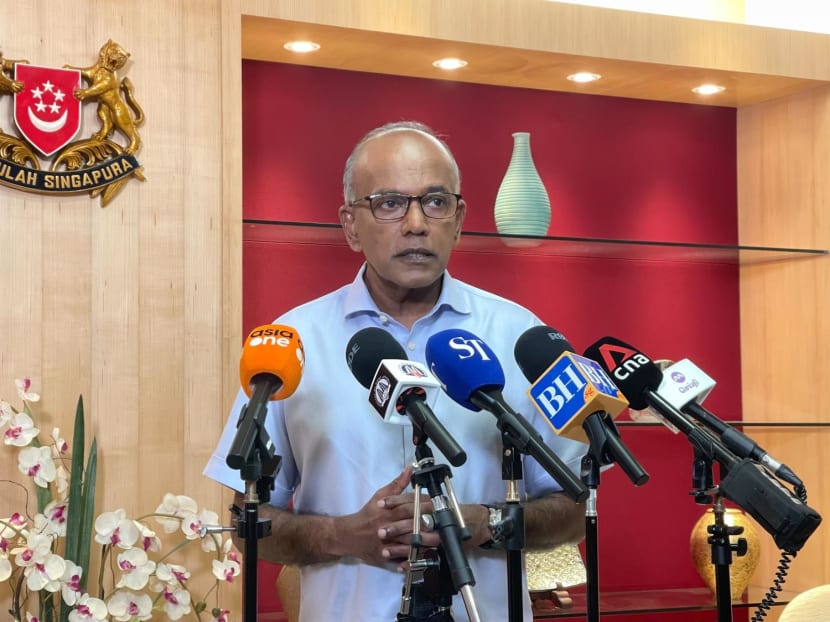
Law and Home Affairs Minister K Shanmugam speaking to reporters on Monday (March 25) about a Facebook post by
the Israeli embassy in Singapore, which local authorities asked to be taken down. 
Ili Nadhirah Mansor/TODAY

March 25, 2024


SINGAPORE — Singapore authorities told the Israeli embassy to remove a post made on its Facebook page on Sunday (March 24) that Minister for Law and Home Affairs K Shanmugam called an "astonishing attempt to rewrite history".

The post was “insensitive”, “inappropriate” and “completely unacceptable” as it carried the risk of undermining safety, security and harmony in Singapore, he said.

Tuesday, March 16, 2021

Malaysia government appeals ruling on Christians using 'Allah'

15 Mar 2021

KUALA LUMPUR: The Malaysian government on Monday (Mar 15) appealed a court's decision to overturn a decades-old official ban and allow Christians in the Muslim-majority country to use "Allah" to refer to God.

The word has long been divisive in multi-ethnic Malaysia, with Christians complaining that attempts to stop them using it highlight the growing influence of conservative Islam.

But some Muslims accuse the sizeable Christian minority of overstepping boundaries, and the subject has fuelled religious tensions and sparked violence over the years.

Last week the Kuala Lumpur High Court ruled that Christians can use "Allah" in publications, siding with a member of the minority and striking down a ban that dated back to 1986. [See below.]

Wednesday, April 17, 2019

News analysis: A ‘new Malaysia’ but same old racial, religious divide

By Faris Mokhtar in Kuala Lumpur

11 December, 2018


KUALA LUMPUR — Malaysia’s Pakatan Harapan (PH) government, which swept into power in May through a significant swing in the Malay vote, should be under no illusion that the Malay voters bought into its progressive ideology, analysts told TODAY.

If there were ever any doubt, the 50,000-strong turnout for last weekend's rally at the historic Dataran Merdeka (Independence Square) sent a loud and clear message: Malay rights and Islam’s status as the national religion must remain enshrined in the country’s Constitution.

As it becomes increasingly clear that the groundswell of support for PH during the elections had largely stemmed from voter dissatisfaction with corruption in the previous Barisan Nasional (BN) government, the opposition United Malays National Organisation (Umno) and Parti Islam Se-Malaysia (PAS) are now ready to pounce and play the race and religion cards to win over the hearts and minds of the majority Malay population, the analysts said.

[Ok. So BN's corruption not an issue anymore?]

Thursday, August 16, 2018

Arabisation and the threat to Singapore culture

By Norshahril Saat

14 August, 2018


In Indonesia, there is an ongoing movement that promotes Islam Nusantara (Archipelagic Islam), a localised brand of Islam.

The country’s largest Islamic organisation, Nahdlatul Ulama, is championing the discourse. Recently, the West Sumatra chapter of the Ulama Council of Indonesia openly voiced its displeasure with Islam Nusantara, declaring that Islam is already perfect.

Promoters of Islam Nusantara are clear of its objective: to prevent the excessive borrowing of foreign ideas into the Indonesian Islamic discourse.

Their top concern is rising radicalism and the importation of Middle Eastern culture at the expense of local norms, a phenomenon referred to as Arabisation.

Unfortunately, the Malay/Muslim community in Singapore does not seem interested in this whole Islam Nusantara debate, even though a trend towards Arabisation is evident.

Friday, March 9, 2018

S’pore’s first Islamic college could have broad-based curriculum to equip students with employable skills

By Faris Mokhtar

The Republic’s first Islamic college could have a broad-based curriculum which teaches Islamic sciences as well as equips students with skills so that they can also be employed in the general workforce, said Minister-in-charge of Muslim Affairs Yaacob Ibrahim

Friday, May 19, 2017

Hot dog issue has made Malaysia famous for the wrong reason: The Star columnist

May 18, 2017

Wong Chun Wai


PETALING JAYA (THE STAR/ASIA NEWS NETWORK) - Looks like the monsoon season is starting soon. That is when it starts to rain cats and dogs. No, these animals will not fall from the skies, but it is best that Malaysians are well-prepared for the floods.

The authorities, we are very sure, will not let anyone be confused. Personnel from the Civil Defence Force and Fire Department are already on standby to face the wettest month of the year.

According to one report, tourists will almost certainly experience thunderstorms and floods - they have been predicted to take place on 83 per cent of the 25 days with rainfall. Light rain may also occur but is rare, being observed on only 11 per cent of those days.

This means our rescue teams can be expected to work really hard and as one will say - work like a dog.

Wednesday, July 20, 2016

Arabisation of Islam in Asia: A clash within civilisation

Baladas Ghoshal
For The Straits Times

JUL 19, 2016

The spate of terrorist attacks and the attendant violence witnessed in the last couple of months, including the recent attacks in Dhaka, Kishoreganj and Ektarpur in Bangladesh, and Nice in France, brings home the truth that something perverse is happening within Islam and Muslims alone can fight that scourge.

Analysts attribute the growth of Islamist radicalism to Muslim grievances about their culture and way of life not being given what they consider their rightful place in their own societies; transnational links with organisations like Al-Qaeda and now an even more dangerous phenomenon called the Islamic State in Iraq and Syria or Daesh; hostility towards the policies of the West, in particular the United States and its support of Israel's policies towards the Palestinians, the occupation of Iraq and now intervention in Syria; and opposition to crackdowns on domestic militancy like in Bangladesh.

These factors have, undoubtedly, contributed to a sense of growing alienation and feeling of victimisation and oppression among certain Muslim groups, and to an attempt to redress their grievances and frustrations through violence and terror.

More importantly, a fundamental transformation is taking place within the Muslim community all over the world - an identity formation based on a world view taken from early Quranic precepts and a code of conduct resembling a way of life that was prevalent in the Arab world in the mediaeval period during the formative stage of Islam.

Thursday, March 24, 2016

Stop trying to be like Arabs, Johor ruler tells Malays

Mar 24 2016


JOHOR BARU (The Star/Asia News Network) - The Sultan of Johor has called on Malays not to discard their unique culture, saying he was disturbed that some people want to stop Muslims from practising the traditional salam greeting.

Sultan Ibrahim Ibni Almarhum Sultan Iskandar said he was sticking to "my customs and traditions as a Malay because I'm born Malay".

"If there are some of you who wish to be an Arab and practise Arab culture, and do not wish to follow our Malay customs and traditions, that is up to you.

"I also welcome you to live in Saudi Arabia.

"That is your right but I believe there are Malays who are proud of the Malay culture. At least I am real and not a hypocrite and the people of Johor know who their ruler is," he said.

Tuesday, January 5, 2016

How do Sunni and Shia Islam differ?

January 4, 2016

NEW YORK — Saudi Arabia’s execution of Shiite cleric Sheikh Nimr al-Nimr could escalate tensions in the Muslim world even further. In the Shiite theocracy Iran, the supreme leader, Ayatollah Ali Khamenei, said yesterday (Jan 3) that Saudi Arabia, which is ruled by a Sunni monarchy, would face “divine vengeance” for the killing of the outspoken cleric, which was part of a mass execution of 47 men. Al-Nimr had advocated for greater political rights for Shiites in Saudi Arabia and surrounding countries. Saudi Arabia had accused him of inciting violence against the state.

Here is a primer on the basic differences between Sunni and Shia Islam.

Monday, December 7, 2015

Wahhabism to ISIS: how Saudi Arabia exported the main source of global terrorism

Although IS is certainly an Islamic movement, it is neither typical nor mired in the distant past, because its roots are in Wahhabism, a form of Islam practised in Saudi Arabia that developed only in the 18th century.

27 Nov 2015

BY KAREN ARMSTRONG

As the so-called Islamic State demolishes nation states set up by the Europeans almost a century ago, IS’s obscene savagery seems to epitomise the violence that many believe to be inherent in religion in general and Islam in particular. It also suggests that the neoconservative ideology that inspired the Iraq war was delusory, since it assumed that the liberal nation state was an inevitable outcome of modernity and that, once Saddam’s dictatorship had gone, Iraq could not fail to become a western-style democracy. Instead, IS, which was born in the Iraq war and is intent on restoring the premodern autocracy of the caliphate, seems to be reverting to barbarism. On 16 November, the militants released a video showing that they had beheaded a fifth western hostage, the American aid worker Peter Kassig, as well as several captured Syrian soldiers. Some will see the group’s ferocious irredentism as proof of Islam’s chronic inability to embrace modern values.

Malaysia moving towards ‘apartheid’ tendencies, NUS academic warns

DECEMBER 6, 2015

KUALA LUMPUR — Malaysia is on a slippery slope towards authoritarian nationalism with “apartheid” tendencies, a professor from the National University of Singapore (NUS) said today (Dec 6).

Dr Syed Farid Alatas, a Malaysian who teaches at NUS, highlighted as examples the proposed supermarket trolleys for non-halal food, a school’s plan for separate classrooms for non-Muslim students, and a Bumiputera-only gadget mall that is set to open this month.

“The lack of a multicultural approach, whether it’s towards Shiites, Sufis, anti-Christianity...we’re on the slippery slope towards very strong authoritarian nationalism with, I would add, apartheid tendencies,” Dr Syed Farid told a forum organised by G25, a group of retired Malay senior civil servants, here on Islam and democracy.

“Next thing that will come is — some Muslims will say I feel offended seeing the non-halal section in supermarkets. ‘When I peep into the section, I can see pork and alcohol’. They’ll say, ‘let’s have separate supermarkets’,” the associate professor of sociology added.

Sunday, November 1, 2015

Malaysia’s ‘Islam’ has negative impact on Singapore, says lecturer

MSN

From The Malaysian Insider

by Hasnoor Hussain, 

October 31, 2015. 

Malaysia’s brand of Islam has a negative impact on its neighbour across the causeway, a Singaporean academic said today.

Dr Nawab Osman, from Nanyang Technology University, said a puritanical mindset and intolerance has begun to seep into Singapore and Malaysia was one of the contributing factors.

“Singapore is where Malaysia was about 10 years ago. The impact of Malaysia’s Islam is real.

“When (well-known Malaysian preacher) Ustaz Azhar Idrus came to Singapore, 10,000 people went to his talk,” he said at the “Maqasid Shariah in a Constitutional Democracy” forum in Penang organised by G25 and think tank Penang Institute today.

Speaking on Islamic revivalism and its socio-political impact, Nawab cited incidents in the island republic such as the issue of Muslim women wearing headscarves, as an indication of the shift of Islam in Singapore.

Sunday, March 29, 2015

Why Islamic State’s call for new Caliphate is flawed

The Caliph was also the protector of Islam’s holy places, primarily Mecca as well as Medina and Jerusalem, which are not in the hands of the Islamic State. This role included various duties and responsibilities. Clearly, the Islamic State is in no position to make these claims.


PAUL MICHAEL HEDGES

MARCH 27, 2015

The claimed authority of the (self-proclaimed) Islamic State, or Daesh, is tied to its being a new Caliphate. The Caliph, literally the “one who replaces someone (dead or gone)”, is variously understood as the successor or deputy to Islam’s Prophet, or even as God’s regent on earth.

Therefore, some claim that it is the duty of all Muslims to follow the Caliph as successor of the Prophet. In using this motif, the Islamic State is investing in a deeply potent symbol. However, this raises questions, including: What makes someone a Caliph; do you have to follow a Caliph; and how do you recognise a Caliph?

If Abu Bakr Baghdadi is the Caliph, then is every Muslim duty-bound to follow him? Seduced by the claim, many thousands of Muslims do so. However, why do they think they should and what role does the media play in promoting his claim?

Friday, February 13, 2015

Reading The Bible Like We Read The Quran

From HuffPost


10 Feb 2015


Only 0.6% of the population in the United States is Muslim.

Most of us in the 99% haven't even held a Quran in our hands.

Yet, remarkably, we are a country full of Islamic experts; many of whom are self-professed Christians.

From Facebook to cable news to talk radio, we're a nation swarming with folks convinced they know what Islam is really about and we've got verses from the Quran to prove it.

Armed with these contextless passages from a book we've never read and know nothing about about, we beat the drums of war and sanctify our hatred. Not simply against ISIS, but against anyone of a different skin color who reads the Quran and worships at a mosque.

But here's the thing....

If we cherry-pick verses from the Bible the way we cherry-pick verses from the Quran, we can "read" the Bible exactly like we "read" the Quran and come to the exact same conclusions about Christianity that we do about Islam being a religion of hate, violence, and oppression.

Wednesday, January 21, 2015

Guantanamo Diary: A chronicle of hell

TODAY


BY JOE NOCERA

JANUARY 21

Last week, several United States Republican Senators, including Mr John McCain, called on President Barack Obama to stop releasing detainees from the prison at Guantanamo Bay, Cuba. Their argument was that after the terror attacks in Paris, the 122 prisoners still in Guantanamo should be made to stay right where they are, where they can do the West no harm.

Yesterday, one of those detainees, Mr Mohamedou Ould Slahi, who was sent to Guantanamo in 2002 and remains there to this day, offered a powerful rejoinder. Three years into his detention — years during which he was isolated, tortured, beaten, sexually abused and humiliated — Mr Slahi wrote a 466-page, 122,000-word account of what had happened to him up to that point.

His manuscript was immediately classified, and it took years of litigation and negotiation by Mr Slahi’s pro bono lawyers to force the military to declassify a redacted version. Even with the redactions, Guantanamo Diary is an extraordinary document — that everyone should read. “A vision of hell, beyond Orwell, beyond Kafka,” British author John le Carre aptly describes it in a back cover blurb.

FAIR TO ALL, EVEN HIS TORTURERS

A native of Mauritania, Mr Slahi, 44, is fluent in several languages — he learnt English while in Guantanamo — and lived in Canada and Germany as well as the Muslim world.

He came under suspicion because an Al Qaeda member, who had been based in Montreal — where Mr Slahi had also lived — was arrested and charged with plotting to bomb the Los Angeles International Airport in 1999. Mr Slahi was questioned about this plot several times, but he was always released.

After 9/11, Mr Slahi was detained again for questioning. That time, he was turned over to the American authorities, in whose captivity he has been ever since.

What was he accused of? Mr Slahi asked this question of his captors often and was never given a straight answer. This, of course, is part of the problem with Guantanamo, a prison where being formally charged with a crime is a luxury, not a requirement.

His efforts to tell the truth — that he had no involvement in any acts of terrorism — only angered his interrogators. “Looks like a dog, walks like a dog, smells like a dog, barks like a dog, must be a dog,” one interrogator used to say. That was the best his captors could do to explain why he was there.

The military was so sure he was a key Al Qaeda player that he was subjected to “special interrogation techniques” that had been signed off by the then-Secretary of Defence Donald Rumsfeld himself.

Special interrogation techniques, of course, is a euphemism for torture. The sections of the book that describe his torture make for harrowing reading. Mr Slahi was so sleep-deprived that he eventually started to hallucinate. Chained to the ground, he was forced to “stand” in positions that were extremely painful. Interrogators went at him in shifts — 24 hours a day. Sometimes during interrogations, female interrogators rubbed their breasts over his body and fondled him.

It is hard to read about his torture without feeling a sense of shame.

Does Mr Slahi crack? Of course; to get the torture to stop, he finally lied, telling his interrogators what he thought they wanted to hear, just as torture victims have done since the Inquisition.

“Torture doesn’t guarantee that the detainee cooperates,” writes Mr Slahi. “In order to stop torture, the detainee has to please his assailant, even with untruthful and, sometime, misleading (intelligence).”

Mr McCain, who was tortured in Vietnam, knows this. Last month, he made a powerful speech in which he condemned America’s use of torture, saying the use of torture compromises that which most distinguishes Americans from their enemies: Their belief that all people, even captured enemies, possess basic human rights.

That is also why it is so disheartening that Mr McCain has allied himself with those who want to keep Guantanamo open.

In 2010, a US federal district judge ruled in favour of Mr Slahi’s habeas corpus petition because the evidence against him was so thin. The government appealed and the order remains in limbo.

I asked Ms Nancy Hollander, one of Mr Slahi’s lawyers, to describe her client. “He is funny, smart, compassionate and thoughtful,” she said. All of these qualities come through in his memoir, which is surprisingly without rancour.

“I have only written what I experienced, what I saw and what I learnt firsthand,” he writes towards the end of his book. “I have tried not to exaggerate, nor to understate. I have tried to be as fair as possible, to the US government, to my brothers and to myself.” One of the wonders of the book is that he does come across as fair to all, even his torturers.

But the quote that sticks with me most is something that one of his guards told him, something that could stand as a fitting epitaph for Guantanamo itself: “I know I can go to hell for what I did to you.” 

THE NEW YORK TIMES

ABOUT THE AUTHOR:

Joe Nocera is a business journalist, author and op-ed columnist for The New York Times.
Wednesday, October 8, 2014

Two Ang Mos claim that ISIS is Islamic

Two Ang Mos claim that ISIS is Islamic, so that they can pursue the thing that Ben Affleck spoke out against.

Obama Is Wrong That ISIS Is 'Not Islamic'

Alastair Crooke
Fmr. MI-6 agent; Author, 'Resistance: The Essence of Islamic Revolution'

09/18/2014

"We are fighting an ideology, not a regime." - U.S. Secretary Of State John Kerry
"Now let's make two things clear: ISIL is not 'Islamic.' No religion condones the killing of innocents, and the vast majority of ISIL's victims have been Muslim. And ISIL is certainly not a state. It was formerly al-Qaeda's affiliate in Iraq, and has taken advantage of sectarian strife and Syria's civil war to gain territory on both sides of the Iraq-Syrian border. It is recognized by no government, nor the people it subjugates. ISIL is a terrorist organization, pure and simple. And it has no vision other than the slaughter of all who stand in its way." - U.S. President Barack Obama

Let us be plain: President Obama's (and Kerry's) basic premise that America and its allies are fighting a deviant, un-Islamic ideology, which must, and can be delegitimized by gathering together the Sunni Arab world to pronounce it "un-Islamic," simply underlines how little they "know" about ISIS -- with which they are about to go to war.

There is no "true Islam" in Islam. There has never been any central "authority" in Islam that could define such a thing. For better or worse (mostly for the better), Islam wears many faces. But paradoxically, there is one contemporary orientation that does make the big claim of being "true Islam": Wahhabism.

Tuesday, October 7, 2014

24 reasons ISIS are wrong: Muslim scholars blast Islamic State; Ben Affleck defends Islam against bigotry

25 Sept 2014

A large group of Islamic theologians addressed the head of the Islamic State in an open letter, articulately accusing the movement of practices that have nothing to do with Islam, even rejecting the extremists’ right to call themselves jihadists.

Over a hundred Muslim scholars and clergymen from all over the world have released on Wednesday an address to Islamic State (IS, formerly ISIS) leader Abu Bakr al-Baghdadi, accusing the self-proclaimed caliph and his army of heinous war crimes and violation of fundamental principles of Islam, illiterate use of Islamic scripture torn from the context and perversion of the rules of morality and Sharia law.

“Who gave you authority over the ummah [Muslim people]?” the letter questions. “Was it your group? If this is the case, then a group of no more than several thousand has appointed itself the ruler of over a billion-and-a-half Muslims. This attitude is based upon a corrupt circular logic that says: ‘Only we are Muslims, and we decide who the caliph is, we have chosen one and so whoever does not accept our caliph is not a Muslim,’” the document said.

Wednesday, October 1, 2014

Obama’s Faustian pact with the Saudis

TODAY

September 30, 2014

You go to war with the allies you have, not the ones you wish for, to paraphrase former United States Defence Secretary Donald Rumsfeld. US President Barack Obama’s war on the Islamic State is a good example. His Middle East coalition comprises five autocracies, four of which are monarchies.

To one degree or another, each represses dissent. Each, indirectly or inadvertently, has helped spawn groups such as the Islamic State, Khorasan, Jabhat Al Nusra and, of course, Al Qaeda. Each will reap longer-term profit from assisting the US in its hour of emergency. Things have worked this way in the Middle East for decades. At a moment like this, it would be naive to expect Mr Obama to change that.

Monday, September 22, 2014

Helping the Arabs to help themselves

SEPTEMBER 19

An existential struggle is taking place in the Arab world today. But is it ours or theirs? Before we step up military action in Iraq and Syria, that is the question that needs answering.

What concerns me most about United States President Barack Obama’s decision to re-engage in Iraq is that it feels as if it is being done in response to some deliberately exaggerated fears — fear engendered by YouTube videos of the beheadings of two US journalists and fear that the Islamic State is coming to a mall near you. How did we start getting so afraid again so fast? Did not we build a Department of Homeland Security?

I am not dismissing the Islamic State. Mr Obama is right that the group needs to be degraded and destroyed. But when you act out of fear, you do not think strategically and you glide over essential questions, such as why is it that Shia Iran, which helped trigger this whole Sunni rebellion in Iraq, is scoffing at even coordinating with us, and Turkey and several Arab states are setting limits on their involvement?

Thursday, July 3, 2014

The new 'caliphate': Power plays and the lure of nostalgia

Jul 03, 2014

An Al-Qaeda breakaway group declared on June 29 a "caliphate" in territories it controls in Iraq and Syria. Leader Abu Bakr al-Baghdadi was named the "caliph" and "leader for Muslims everywhere". This excerpt, from an analysis by strategic security intelligence service Soufan Group, looks at the impact of this move on the Middle East and extremist movements.


A CALIPHATE is essentially an administrative unit, but the caliph - as amir al-mu'minin, or leader of the faithful - also has religious authority as both the actual and symbolic leader of all Muslims.

The declaration by the Islamic State in Iraq and Syria (ISIS) may seem far-fetched and even counter-productive in terms of maintaining and securing the secular alliances that it needs to continue its accretion and control of Iraqi territory, but it also plays to deep emotional strands within the Middle East, particularly in extremist circles.