Showing posts with label Water. Show all posts

Tuesday, June 30, 2026

Sixth Desalination Plant?

Video: Singapore studying feasibility of sixth Water Desalination Plant. (CNA)

Points from the video:

  1. 1) Plant may be fully underground.
  2. 2) Study will take about 10 months
  3. 3) Plant to treat both seawater and fresh water
  4. 4) Assess technical feasibility and economic viability of design
  5. 5) Possibly located in Southwest to support industries, and be more energy efficient - currently 2.5 to 3.5 kWh, possibly with 20-30% energy savings. 

Sunday, April 17, 2022

Singapore officially opens fifth desalination plant

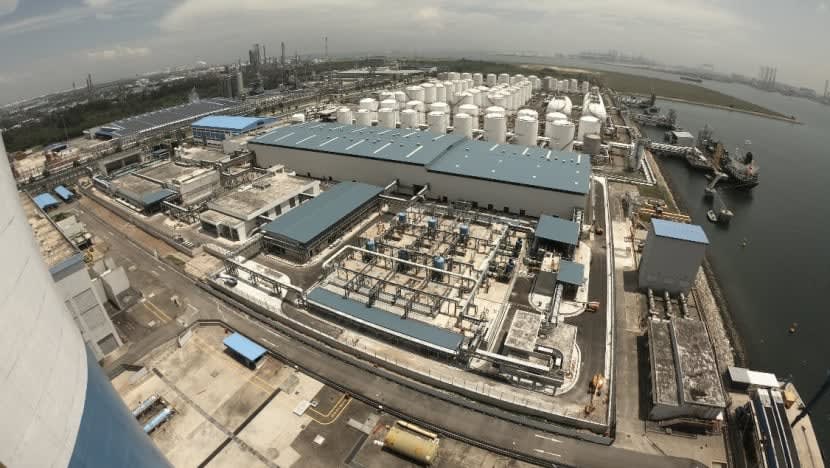
An aerial view of the Jurong Island Desalination Plant.

April 17, 2022


SINGAPORE — Singapore on Sunday (April 17) officially opened the country’s fifth desalination plant, which is about 5 per cent more energy efficient than conventional desalination plants.

Due to its co-location with an existing power plant, the Jurong Island Desalination Plant can save about 5,000 megawatt hours per year, equivalent to the annual power needs of nearly 1,000 Housing and Development Board households.

The new facility, which has been operational since earlier this month, was officially opened by Deputy Prime Minister Heng Swee Keat and Minister for Sustainability and the Environment Grace Fu on Sunday.

The 3.7-hectare plant can produce up to 30 million gallons of fresh drinking water per day, equivalent to 55 Olympic-sized swimming pools of water or up to 7 per cent of Singapore’s daily water demand.

Tuesday, March 23, 2021

Commentary: Reducing household water consumption starts with the toilet bowl

Toilet bowl
Toilet bowl
Toilet bowlBy Ho Xiang Tian

22 Mar 2021 

SINGAPORE: Ask strangers on the street how much water they think a person uses per day at home, and the answers will range from 2 litres to 50 litres.

The answer that most people never got to: More than 140 litres per person, per day. This was something I used to do at outreach booths as part of my volunteer work with LepakInSG, a local environmental group.

We think we consume much less water because we only think about the water we drink, and severely underestimate the water used in other activities like showering, washing the dishes, and flushing.

According to PUB, households account for about 45 per cent of Singapore’s water use, which is significant compared to other metrics like waste generated (25 per cent) and carbon emissions (6 per cent).

Friday, June 7, 2019

Thirsty Singapore taps into innovation to secure its water future

Singapore is the fifth most likely country in the world to face extremely high water stress by 2040, according to the US-based World Resources Institute.

07 June, 2019


SINGAPORE — Every day after his morning run, Mr Adam Reutens-Tan washes under a half-full camping shower hooked on the ceiling of his bathroom.

The modified shower, which uses just four litres of water, is one of several ways the Reutens-Tan family conserve water as part of a countrywide push to cut Singapore's daily consumption by 8 per cent by 2030.

The nation currently uses 141 litres per person each day — about enough for two typical eight-minute US showers, according to Harvard University statistics.

Singapore, a steamy, low-lying island city-state, is the fifth most likely country in the world to face extremely high water stress by 2040, according to the US-based World Resources Institute.

Thursday, June 6, 2019

From making waves to drowning in red ink: Hyflux, Tuaspring and how a business giant came undone

As Hyflux’s dramatic debt restructuring continues to unfold, its flagship Tuaspring desalination plant was taken over on Saturday (May 18) by PUB at no cost. CNA looks back at how the ambitious project started - and then floundered.


ByTang See Kit

18 May 2019


SINGAPORE: As they arrived, the guests would have been in no doubt they were attending a high-profile event.

Huge balloons and congratulatory flowers festooned the area. Drummers and a Chinese orchestra revved up the celebratory atmosphere. Photographers clicked away as guests streamed in and warm handshakes were exchanged.

At the centre of it all was Olivia Lum, the founder of home-grown star company Hyflux.

Dressed in a black and white pant suit, the businesswoman, whose name was synonymous with the water treatment giant she built, had a broad smile when the day’s special guest, Singapore’s Prime Minister Lee Hsien Loong, arrived.

It was a happy day, as seen from the scenes captured by a video on Youtube.

The event was the opening of Tuaspring desalination plant – Singapore’s second and largest seawater treatment plant supplying 70 million gallons of treated water, or 125 Olympic-sized pools worth of water, per day for 25 years.

It was also the first water plant in Singapore and Asia to be integrated with a power generator.

Wednesday, May 8, 2019

Biggest threat to Johor River’s sustainability is lack of environmental protection: Vivian Balakrishnan


By Aqil Haziq Mahmud

08 May 2019

SINGAPORE: Foreign Affairs Minister Vivian Balakrishnan on Wednesday (May 8) warned that the "biggest threat" to the sustainability of the Johor River was a lack of environmental protection, as he urged Malaysia to safeguard water quality for the benefit of both sides.

"The biggest threat to Johor's own water supply is actually the lack of environmental protection," Dr Balakrishnan told Parliament. "And the seven episodes since 2017 ... are a clear and present amber warning light."

PUB's Johor River Waterworks temporarily shut down in 7 pollution incidents since 2017: Masagos

CHANNELNEWSASIA

07 May 2019 

SINGAPORE: There have been seven pollution incidentsalong the Johor River since 2017 that caused PUB's Johor River Waterworks to be temporarily shut down, said Minister for the Environment and Water Resources Masagos Zulkifli on Monday (May 6).

Mr Masagos said this in a written response to parliamentary questions by Member of Parliament Seah Kian Peng on the impact that prolonged stoppage of the water treatment plant's operations had on Singapore, as well as Singapore's obligations to provide treated water to Johor under such a scenario.

"PUB will shut down its Johor River Waterworks when the Johor River is affected by pollution upstream of our waterworks," said Mr Masagos.

"Johor also has water treatment plants along the Johor River, upstream of the Johor River Waterworks, and will shut down the plants when pollution occurs upstream of them."

Friday, March 29, 2019

What’s life like after climate change? One city offers plenty of clues

Residents collect water from a communal tap in a settlement
outside of Cape Town.
By SIMON KUPER

29 MARCH, 2019

THE NEW YORK TIMES

In the flat where I stayed in Cape Town last month, the bathtub felt like a relic of a lost civilisation. It may never be used again. Beside it was a shower containing an egg timer. The two-minute wash has been standard here since the recent three-year drought. In the city’s public bathrooms, a dribble comes out of the tap. Posters everywhere warn against wasting water.

This is what adapting to climate change looks like. Last year, Cape Town nearly became the first big city on earth to run dry. Daily water rations dropped to 50 litres per person per day, with the spectre of 25 litres if supplies ran out on “Day Zero”.

The drought broke just in time, but the city’s planners now expect permanent water scarcity. Rationing, which initially felt like wartime austerity, has become normal.

Wednesday, March 27, 2019

Investor watchdog questions PUB after ‘serious concerns’ raised over takeover move for Tuaspring plant

By Kenneth Cheng

26 March, 2019


SINGAPORE — The Securities Investors Association Singapore (SIAS) has written an open letter to national water agency PUB about its move to take over Hyflux’s Tuaspringdesalination plant — if Tuaspring cannot fix its defaults by April 5 — after the firm’s investors raised “serious concerns”.

In its letter on Monday addressed to PUB chief executive officer Ng Joo Hee, SIAS president David Gerald said Hyflux’s retail investors were caught in a predicament, as the company possibly faces liquidation.

The SIAS is Singapore’s retail investor watchdog.

Wednesday, January 9, 2019

Singapore supplies additional treated water to Malaysia at Johor's request

ChannelNewsAsia

6 Jan 2019


SINGAPORE: Singapore's water agency PUB said on Sunday (Jan 6) that it supplied additional treated water to Malaysia this week after pollution disrupted production at Johor's water plants.

"Production at Johor's water plants was disrupted recently by pollution to the river catchment. PUB's Johor River Waterworks was not affected by the incident," said PUB in a statement.

"At Johor’s request, PUB helped to tide Johor residents over the water supply disruption by turning on PUB’s Pasir Gudang offtake and supplying an additional 6 million of gallons per day (mgd) of treated water between 2 and 4 January 2019.

"This was on top of the 16 mgd that we usually supply Johor," it added.

Singapore is required to supply Johor with 5 mgd of treated water, said PUB, citing the 1962 Water Agreement.

"In practice, we have been supplying 16 mgd of treated water to Johor at their request. On top of this, between 2 and 4 January 2019, we have supplied a further 6 mgd of treated water (above the 16 mgd of treated water) to Johor when it needed more water because its water plants experienced pollution.

Tuesday, January 8, 2019

Over RM13b needed to reduce NRW — SPAN

[This is an old article (note the date) which I looked up for another story about Johor requesting water from SG. And how the water supply system in MY is so bad that the Non-Revenue Water (NRW) or water lost to leakage or theft, is more than 25%!]

Kamarul Anwar

The Edge Financial Daily

July 26, 2016


This article first appeared in The Edge Financial Daily,on July 26, 2016.


CYBERJAYA: The regulator of Malaysia’s water industry estimates that more than RM13 billion worth of investment in water distribution systems is needed to achieve its non-revenue water (NRW) target of 25% by 2020.

It, however, remains to be seen when the investment can be put into place. More than 10 years after the federal government put into law that it will be the sole custodian of water assets in an effort to cool down the country’s escalating costs to supply treated water, only seven states have handed over their assets to Putrajaya.

Friday, December 21, 2018

Beat the heat: More affluent households turn on air-con, lower-income ones use water

By Wong Pei Ting

20 December, 2018


SINGAPORE — A study of water and electricity bills of more than 100,000 households here has found a marked difference in the way Singaporeans of different socio-economic statuses cope with the heat.

Higher-income households tend to use electricity — likely through the use of air-conditioning — for relief when temperatures rise, while those with lower incomes tend to rely on water — by bathing more often, and longer.

A 1°C rise in temperature can cause an average household living in a two-room apartment to increase its water use by nine litres a day, showed the research conducted by National University of Singapore (NUS) economics professor Alberto Salvo.

This translates to one additional shower daily for every 2.3 households.

Wednesday, August 29, 2018

Singapore and Malaysia must follow terms of water and HSR agreements, says PM Lee

TODAY

By Faris Mohktar

20 August, 2018


SINGAPORE – While Singapore appreciates the new Malaysia government's reasons to review and change various policies of the previous administration, Prime Minister Lee Hsien Loong made it clear on Sunday (Aug 19) that both countries have to adhere to agreed terms relating to water prices and the Kuala Lumpur-Singapore High-Speed Rail (HSR) project.

Both issues have been sticking points in recent months, with Malaysia's Prime Minister Dr Mahathir Mohamad repeatedly saying that his country is selling water to Singapore at too low a price, and most recently, suggesting that it should be raised by at least 10 times.

Shortly after winning the May 9 general election, Dr Mahathir had also said that Malaysia wants to cancel the HSR project, though Putrajaya has since shifted its position to wanting to defer the project.

Commenting on both issues for the first time at the National Day Rally, Mr Lee stressed that the 1962 Water Agreement between the two neighbours is "sacrosanct".

"We must proceed strictly in accordance with its terms," he said.

Thursday, August 23, 2018

Three key principles on how Singapore handles foreign policy and ties with Malaysia

TODAY

By Vivian Balakrishnan

10 July, 2018


Foreign Affairs Minister Vivian Balakrishnan told Parliament on Monday (July 9) that three fundamental principles underpin Singapore's foreign policy, and these are particularly pertinent in the Republic's ties with Malaysia.

The principles are: Upholding international law and respecting the sanctity of international agreements, resolving disputes in accordance with international law and maintaining Singapore's reputation as a credible and consistent nation that abides fully by her international obligations.

Below is a transcript of Dr Balakrishnan's parliamentary speech, in which he also touched on Malaysia's recent announcements that it was cancelling the high-speed rail project between Kuala Lumpur and Singapore and seeking a review of the 1962 Water Agreement between both sides.

Tuesday, July 24, 2018

Exclusive: Johor crown prince claims 'sovereignty' over water in the state, prefers ‘no federal interference’ on the issue

By Amir Yusof

19 Jul 2018

CHANNELNEWSASIA


JOHOR BAHRU: The crown prince of Johor, Tunku Ismail Sultan Ibrahim, has said that water in the state belongs to the state government, and he prefers that the federal government not interfere on the issue, as it relates to the existing agreement with Singapore.

Speaking in an exclusive interview with Channel NewsAsia on Thursday (Jul 19), he stressed that water is an issue over which the state has sovereignty, and that the Johor state government should decide on a “win-win” agreement with Singapore.

“At the end of the day, the water in Johor belongs to Johor. Water is state sovereignty. When it comes to religion, land and water, it belongs to the state. Therefore, I think it's the Johor state government (that) should decide. (I prefer) not to have federal interference when it comes to water between Johor and Singapore,” said Tunku Ismail.

Thursday, July 5, 2018

PUB aims to double water supply by 2060 without using more energy, producing more waste

By Louisa Tang

04 July, 2018

TODAY


SINGAPORE — National water agency PUB has set a target to double the amount of clean water it produces today by 2060 without using more energy.

That is one of several long-term goals that the PUB committed to on Wednesday (July 4), as it soldiers on with research and development (R&D) efforts to increase water resources for the future and improve water treatment efficiency.

Through new technologies, it aims to reduce the energy used in desalination by more than two-thirds, increase the amount of NEWater recovered from used water to 90 per cent at low energy levels, and produce as much energy as it uses in treating used water.

Tuesday, July 3, 2018

On water issue, Dr M again risks crossing a red line for Singapore

TODAY

By Nicholas Fang

02 July, 2018


When Malaysia's opposition alliance, Pakatan Harapan, won the May 9 general election, many in the country hoped for a government that could stem corruption and move forward with reform.

Many Malaysians admired the commitment and extraordinary energy of Dr Mahathir Mohamad and believed that no other single person did more to secure the stunning upset.

Across the Causeway, some Singaporeans expressed admiration for how Malaysia managed to peacefully transition from a coalition that had been in power for over six decades to a new government.

Others however started to brace themselves for a return to a testier relationship with their northern neighbour.

Younger Singaporeans celebrating Dr Mahathir’s electoral success may not remember this, but the last time he led Malaysia, bilateral ties were marked by what ousted prime minister Najib Razak described as “confrontational diplomacy and barbed rhetoric”.

Monday, July 2, 2018

Singapore opens its third desalination plant in Tuas

CHANNELNEWSASIA

28 June 2018

Lianne Chia

Vanessa Lim


SINGAPORE: Singapore on Thursday (Jun 28) opened its third desalination plant, boosting the country’s desalination capacity from 100 to 130 million gallons a day (mgd).

The Tuas Desalination Plant, which can produce 30 million gallons of drinking water a day, will help to meet up to 30 per cent of Singapore’s current water demand.

Spanning just 3.5ha - the size of three rugby fields - Tuas Desalination Plant is the country’s smallest plant to date.

Despite its size, the plant can produce the same amount of drinking water as SingSpring Desalination Plant, Singapore’s first such plant.

SingSpring occupies 6.3ha, nearly double the footprint of Tuas Desalination Plant. Advertisement

Both plants can produce up to 30mgd of drinking water, which is enough to supply to 200,000 households.

The first to be owned and operated by PUB, the Tuas plant will also be used to test new energy-saving technologies.

Singapore’s Water Cycle Wizardry

28 May 2010

IEEE Spectrum

Singapore’s toilet-to-tap technology has saved the country from shortages—and a large electricity bill

By Sandra Upson

Singapore began its journey to sovereignty with a mighty jolt. The island was still an exotic outpost of the British Empire when World War II delivered the shake-up. Japan’s army was preparing to invade from the Malay Peninsula, and the British forces beat a retreat to Singapore across the one bridge connecting it to the mainland. To thwart the Japanese troops, the Royal Engineers blew up the bridge behind them.

The blast sealed the island’s doom, for it also ruptured a critical pipeline that brought water from Johor, a Malay state. The people of Singapore discovered they had only a few days’ water stored in their meager reservoirs. The island was truly defenseless. The Japanese swiftly repaired the bridge, bicycled across the strait, and claimed victory.

Sixty-eight years later, this port city has both gained territorial independence and managed to bootstrap its way to wealth in spite of a lack of water and energy. And now, against all odds, complete water independence—from both Malaysia and even the weather—is within easy reach. Rather than flushing waste into the sea, the water utility collects the country’s wastewater, cleans it to pristine levels, and returns it to the public supply. Singapore has thus short-circuited the water cycle by reducing it to an island-ringing loop.

Thursday, June 28, 2018

Johor crown prince warns that state may secede if Putrajaya breaches federation's terms

Straits Times

Oct 16, 2015,

[Note the date of this news article. The Johor Sultanate has been entertaining the idea of secession from the Federation even as early as 2015. And probably before. It may not be the most feasible option, but it is clearly not unthinkable. But why am I putting this old news out now?]

KUALA LUMPUR - Johor has a right to secede from Malaysia if there is a breach of the terms agreed upon at the time of its membership to the Federation of Malaya, crown prince Tunku Ismail Ibrahim has said in a new interview.

In the interview with local football portal FourthOfficial, the prince said that as future Sultan of Johor, his duties were towards the state and its people before Malaysia, reported The Malay Mail Online.

"In fact, we only joined the Federation of Malaya upon both parties agreeing to several basic terms. And if any one of those terms are breached, we have every right to secede from this country," Tunku Ismail said.