Showing posts with label Mystery. Show all posts

Tuesday, June 4, 2019

‘Wow, what is that?’ US Navy pilots report unexplained flying objects


01 June, 2019

WASHINGTON — The strange objects, one of them like a spinning top moving against the wind, appeared almost daily from the summer of 2014 to March 2015, high in the skies over the East coast.

Navy pilots reported to their superiors that the objects had no visible engine or infrared exhaust plumes but that they could reach 30,000 feet and hypersonic speeds.

“These things would be out there all day,” said Lt. Ryan Graves, an F/A-18 Super Hornet pilot who has been with the Navy for 10 years and who reported his sightings to the Pentagon and Congress. “Keeping an aircraft in the air requires a significant amount of energy. With the speeds we observed, 12 hours in the air is 11 hours longer than we’d expect.”

In late 2014, a Super Hornet pilot had a near collision with one of the objects, and an official mishap report was filed. Some of the incidents were captured on video, including one taken by a plane’s camera in early 2015 that shows an object zooming over the ocean waves as pilots question what they are watching.

“Wow, what is that, man?” one exclaims. “Look at it fly!”

Wednesday, August 1, 2018

MH370 The Final Report (July 2018)

Spoiler alert: The conclusion is that there is no conclusion.

Here is the 400+ page report. On page 443, the conclusion is... they are unable to determine the cause of MH370's disappearance.

Here is a 9 minute video on the findings of the report:


DJ's Aviation does not go into any speculation, and respectfully reports the content of the report, and keeps his opinion (if any) out of his commentary, and does not cast aspersions on the Pilot's integrity or imputes any felonious intent or motivation.

Sunday, December 10, 2017

Naming Singapore


[From over a year back - on the naming of Singapore. Two... "perspectives".]


Origin of 'Singapore' found in old maps


If we look at maps going back 500 years, we can form an alternative thesis for how Singapore got its name ("No lions in S'pore but..."; May 21).

Starting in 1502, maps of the region named the Malaysian peninsula south of Malacca with variations of the name "Barxingapara".

By the 1550s, the part of Malaysia east of Changi was called "Cape Cincapula".

The first known example of a name on the island we now inhabit comes from a hand-drawn Dutch chart from the late 17th century, where the island is named "T Lang Isyl" (Long Island), while the waterway south is called "Straat Sincapura" (Singapore Strait).

In 1755, Jacques-Nicolas Bellin, a great French mapmaker, published an extremely detailed map of the region, in which our island is named "Pulo ou Isle Panjang" (Long Island), the waterway that separates Singapore from Malaysia is named "The Old Strait of Sincapour" and the waterway to the south, "The New Strait of Sincapour".

It is not until 1787 that we find a map in which the island carries three names: "Paulau Panjang", "Iatana" and "Sincapour".

The historical record is clear: Years before any map located the island of Singapore, maps of the region were calling southern Malaysia "Barxingapara", then there was Cape Cincapula, and then a waterway, Sincapura Straits.

But why "Barxingapara"? Dr Peter Borschberg of the National University of Singapore speculates in his article Singapura In Early Modern Cartography that "bar" means a kingdom of a coastal region, "xin" means "China", and "gapara" is the Javanese word for "gateway".

As Singapore marks the transition from the Indian Ocean to the South China Sea, "The Kingdom of the Gateway to China" may not be as poetic as "Lion City", but has the history of printed maps to support its claim as the real origin of the name of our country.

Eric Rosenkranz


No lions in Singapore but...


We all know how our Lion City got its name, but indulge me for a moment.

"According to legend, Sang Nila Utama, a prince from Palembang (the capital of Srivijaya), was out on a hunting trip when he caught sight of an animal he had never seen before. Taking it to be a good sign, he founded a city where the animal had been spotted, naming it "The Lion City" or Singapura, from the Sanskrit words "simha" (lion) and "pura" (city)." - YourSingapore.com

I heard the name Sang Nila Utama for the first time when, as a newly arrived student in Singapore, I made my tourist's pilgrimage to the Merlion at Sentosa. Nila Utama (Sang being an honorific to show his royal descent) came to life in a cartoon film that co-starred a lion, a raging storm and a sea-monster, with a guest appearance by a prescient stag.

The movie was informative, delightful, engaging - all the things it was supposed to be. But by the time my fellow tourists and I had emerged into the bright sunlight atop the Merlion, Nila Utama and his fable had been replaced with more recent images of gleaming glass skylines and the bustling trade legacy of a multicultural, former-colonial port city: After all, that is what myths are for - to entertain, even astonish and inspire awe, not unlike a fantasy movie saga, but hardly to be taken seriously… aren't they?

Myths aggrandise history, sometimes to the point of distortion, but in doing so they preserve an account of it and ensure that it is transmitted from generation to generation. In all honesty, unless Sang Nila Utama had met the lion or overcome the sea-monster, the millions of visitors to the Merlion wouldn't have ever heard of him. But myth is a twin-edged sword because in aggrandising a story, it sometimes trivialises it. Example:

Me (to person chosen at random): "Hi. Can you tell me who founded Singapore?"

Unsuspecting respondent: "Erm… I think it was Stamford Raffles."

Me: "What about Sang Nila Utama? He came here centuries before Raffles."

Respondent: "That's just a myth. Not real."

And that's where that conversation remained for many years, during the course of which Singapore became home, not just in terms of a tax status but also in very personal ways - love, death, family and career. Even writing is something that happened to me here. It may have been why Sang Nila Utama continued to intrigue me. For a fact, my other books on mythology - or mythohistory as I prefer to call it - have been a means to reclaim identity in one form or another.

Nila Utama was my anchor as I dived into the emotionally loaded question of my identity as Singaporean; a sense of validation that I too belonged here. As a result, the above conversation was extended thus:

Me: "Not real? Why do you say that?"

Respondent (disdainful): "Because there never were any lions in Singapore. The whole story is fluff!"

Now that is an indisputable fact. Lions are not native to this part of the world. Indeed, some suggest that the animal the historical counterpart of Nila Utama may have seen was… wait for it… a tapir.

I like tapirs. I think they are cute and fuzzy. Honestly, I have nothing against them and make it a point to conduct every tired and happily sated visitor I accompany to the Singapore Zoo to the small, unassuming enclosure at the end of the walking trail despite their many protests; that is how much I like tapirs. The Asian in me, however, doesn't quite reckon tapirs on the same plane as lions, with the result that it was disappointing to hold on to the legend of a prince who couldn't tell the deadly, majestic king of the jungle from a harmless tapir as a source of self-validation.

I tried telling myself "it's just a myth". By then, however, I was far too invested - both in Nila Utama's story and the place I called home. Curiosity had turned into questions, sometimes arguments about what defined a nation and its people, what determined belonging and was the fact that I cared not enough to make me belong here. And from this maelstrom was born a book - "3", the story not just of Sang Nila Utama, but more.

The storyline is drawn mainly from the Malay Annals or the Sejarah Melayu, a genealogical work detailing the line of the Malay Sultanate, founded by Iskander Shah around 1390CE. The Annals identify Nila Utama, along with his father and brother, as descended from the skies in mythical magnificence and magical glory, the blood of Alexander the Great in their veins. For all the rhetoric, however, Nila Utama's antecedents remain historically obscure, enough to justify the aforementioned random respondent's view that Singapore's history can be deemed as properly begun only from the times of Sir Stamford Raffles.

"3" is, however, also a tale of the era, a window on how a relatively small geographical region both affects and is affected by global trends of economic and political change. At a time when the Delhi Sultanate is gaining sway across the Indian subcontinent, against the backdrop of Genghis Khan's aspirations to a Mongol empire and the ongoing Crusades across Europe and the Middle East, the seas become the source of political power and prosperity.

Consequently, it is during this period that the Srivijaya Empire, a thalassocratic state broadly comprising the region of the modern-day Indonesian islands, reaches its zenith and inevitably begins its decline. Trade drives the new trend of commerce as conquest, setting the stage for centuries of colonisation and economic dominion and, the Malay Annals tell us, a hundred longships from the Song Emperor fill the harbour at Palembang.

Was this impressive armada in fact a gift from China to the ruler of Srivijaya; an act that then inspired said Srivijaya ruler to give his daughter as wife and his empire as dower to the Song Emperor? Or are they hints at a history of conquest and exile, hidden in metaphor and preserved as myth so that the story would endure through the cusp of religion - and thus sanctioned record - over subsequent centuries and come to us through a variety of narratives: Indonesian, Malay, Indian and even Portuguese.

An important question, for this is where the story really begins. The exiled ruler leaves Palembang, taking with him his family, including his young son, the prince who will, one day, sail to the white-sand shores of Tumasik. What is it that he finds there, hidden in metaphor and preserved as myth; the myth of a lion?

Nila Utama's story is worth telling, not for the fact that he gave our country the name it now bears, but because he did so for a reason. Myth or history, there were those who welcomed Nila Utama on these shores, those who believed that identity comes from wanting to belong. They believed that a nation was made by those who cared. And that is the story that needs be told.

Sure, there were no lions in Singapore… or Tumasik… or whatever names this island once had. And there are, as yet, no categorical answers to the question of who or what Sang Nila Utama was: a coloniser, a refugee or simply a man looking for himself.

As for the rest of it - call it myth if you like, but I want to believe that it was the heart of a lion and the spirit of one that brought Nila Utama… and me… home.

Wednesday, March 11, 2015

MH370 Lithium Batteries Speculation

[So, the underwater locator beacon's battery had expired. But the plane was carrying 221kg of Lithium-ion batteries. Maybe they should've plug those into the beacon... 

Anyway, now the focus is on the batteries. How might this have incapacitated the plane and the crew? (the theory is in the end of this very long post - extract of the possible timeline)
This accident would require a coincidence of timing.
1:07 ACARS transmit status. Lithium Batteries are venting fumes that are filling the cabin, and the cockpit. Crew and passengers are breathing the fumes, but effects are delayed.
1:19 Co-pilot sends last voice contact to KL ATC, and switches radio to Vietnam ATC channel. Batteries ignite. Fire suppression system not yet activated. Smoke starts to fill cargo.
1:22 Fire damages electronics bay and AIMS which disables transmitter/Transponder (and perhaps ACARS). Fire suppression system activates and puts out fire, but without water, the batteries continue to overheat and possibly re-ignite. Halon is again activated and puts out the fire. This can continue to repeat (overheat-ignition-extinguishment-overheat-etc) until the halon is exhausted.
In the cockpit, the flight crew is suffering from the fumes from the lithium batteries, when the fire alarm goes off. They respond to the fire (activate Halon), and makes a distress call but is unable to transmit (fire has disabled AIMS, electronics bay, transmitter?).
Next they turn the plane back, but the cockpit crew is semi-conscious and weakened by the fumes. 
All the above is still speculation.]

Friday, May 2, 2014

Undersea spying and Flight MH370

May 02, 2014

Sophisticated underwater listening systems abound in the seas. It's hard to believe none picked up sound signals from the crash of the Malaysia Airlines plane.


By Joseph Chong For The Straits Times

THE Malaysian government's handling of the loss of Malaysia Airlines Flight MH370 in March has been criticised by many. Much of the criticism, however, is probably unfair.

The event is not only unprecedented, but the Malaysian authorities and the media may well have been recipients of deliberate misinformation from the various authorities involved in the search.

Underwater search capabilities are a very highly guarded area of military expertise. To accentuate the problem, the Indian Ocean is strategic to military planners in the United States, Australia, India, China and Japan. The extent and frequency of (naval) Exercise Malabar involving the US and India are a clear indication of this.

There are good reasons for believing that the black box of the missing aircraft will eventually be found.The British Indian Ocean island of Diego Garcia is not only a base for US strategic bombers and nuclear submarines, but it is also home to a hydro-acoustic data acquisition facility. A 150-tonne aircraft crashing into the Indian Ocean at high speed would have registered prominently on hydrophones around the Indian Ocean.

This is probably the reason that the search team is confident of the approximate location of the crash site despite finding no crash debris on the surface thus far. Satellite Doppler calculations appear to be a nice supplementary cover story.

Thursday, March 27, 2014

MH370: Final Update

[A final compilation of news stories. M'sia has concluded that the plane is lost at sea, specifically the southern Indian Ocean. However their incredible history of contradicting themselves will mean some family members will still hang onto hope.

But perhaps for others, there will be closure. They can start to grieve properly. And then, they can get on with their lives.

And one final theory.

This will be the final update until the plane has been found, or there are concrete evidence of where the plane has gone down.

Where is MH370? This is the visual data from Bloomberg.]

MH370: ‘No survivors’

MARCH 25

Tuesday, March 25, 2014

Search for missing jet exposes limit of China’s power

March 24.

BEIJING — China has not held back in forcing the pace of the search for the Malaysia Airlines Flight MH370. It has deployed 21 satellites and a flotilla of naval ships. It has despatched investigators to Malaysia, run background checks on the Chinese passengers and scoured radar images of its vast western regions. Every day it has cajoled, chided and criticised Malaysian officials.

And still it has come up empty-handed. Two weeks after the plane vanished on an overnight flight to Beijing, no trace of the Boeing 777 jet or the 239 people on board, two-thirds of whom are Chinese, has been found.

Don’t Turn This Malaysian Airlines Pilot Into Flight 370’s Richard Jewell

Mar 17, 2014

The Daily Beast

There was a rush to make him a monster. Judging by the life he left online, the pilot of MH 370 was anything but.

Monday, March 24, 2014

MH370: A mystery, with some revelations

Mar 23, 2014
 
Restoring sense of security calls for right lessons to be drawn
 

It is now more than two weeks since Malaysia Airlines Flight MH370 vanished from the face of the earth, and while hope remains that it might be found, we seem no closer to solving the mystery of what happened, or why.

The mounting anguish of the families waiting for news on their lost loved ones is painful to watch, as is the floundering of the authorities in the face of the searing questions that have inevitably come.

Many have mocked the response, from confusing statements and changing positions to the comic antics of shamans, to the flood of leaks and clarifications, with each day seeming to bring a new lead, theory or explanation.

Those of us looking on might well wonder what would have happened if the ill-fated flight had taken off from Changi Airport instead.


Thursday, March 20, 2014

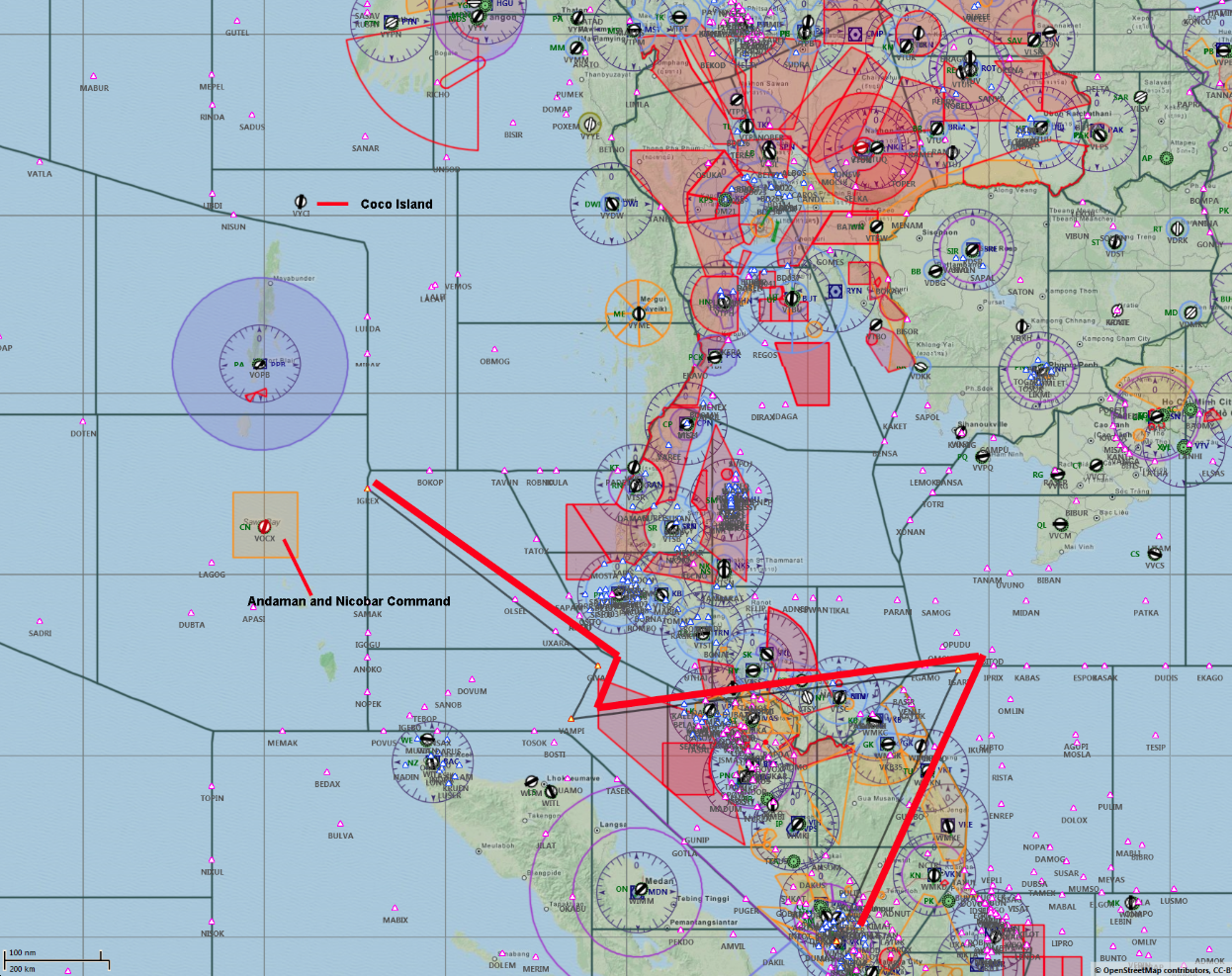
MH370 flight path as tracked? And likely timeline.

The following info were comments and links provide at PPRuNe forum, extracted for reference.

Make of the maps and markings as you like. I cannot explain the markings/legends.

The projected flight path (bold red line in first map) is estimated as the plane was tracked by military radar - Malaysia's and corroborated by Thailand (that such an object/plane was detected by radar). However Thailand claims the aircraft never intruded into Thai airspace, but a straight line from Igari Waypoint to Vampi would have cut into Thai airspace. If Thai statement is true, then the path would not be a straight line.


Wednesday, March 19, 2014

MH370 - separating facts from speculation

Infographic from CNA - summarises the known facts about plane and the last electronic communication.


Tuesday, March 18, 2014

A working hypothesis? Or just more speculation? MH370

Missing Malaysia Airlines Flight 370: Evidence Points To Takeover

The Associated Press

03/16/2014

There are three pieces of evidence that aviation safety experts say make it clear the missing Malaysia Airlines jet was taken over by someone who was knowledgeable about how the plane worked.

TRANSPONDER

One clue is that the plane's transponder — a signal system that identifies the plane to radar — was shut off about an hour into the flight.

Sunday, March 16, 2014

China's Frustration (MH370)

Two articles on China's impotent fury and inability to influence or affect the outcome of the MH370 search.

CNA: Malaysia under fresh fire over handling of plane crisis

16 Mar 2014

BEIJING: China spearheaded fresh criticism on Sunday of Malaysia's handling of a missing airliner drama, saying it "squandered" precious time and resources by releasing dramatic information on the plane's fate a full week after it vanished.

Prime Minister Najib Razak revealed a day earlier that an investigation indicates Malaysia Airlines flight 370 was deliberately diverted and flew for several hours after leaving its intended flight path, though he stopped short of saying it was hijacked.

The startling revelation after a week of confusion and competing theories, prompted questions over how long Malaysian authorities had been privy to the new data, and whether they had missed an opportunity to intercept the diverted plane.

Friday, March 14, 2014

How not to handle a Crisis

In a crisis, accurate information and facts will often be lacking, and the absence of accurate information will mean that rumours and gossip will attempt to fill the vacuum. Information management and misinformation management is key. There is no simple answer as to what is the correct way of handling information and misinformation, except to say, coordinate your efforts, check your facts, and clear all communications through a central authority.

Here is an example of how NOT to do it.

Wednesday, March 12, 2014

MH370 - Speculation, "Spectra-location", and outright mis-reporting, untruths, falsehoods

Nature abhors a vacuum. The news media abhors a factual vacuum. In the absence of facts, speculation will do. Lies rule. Falsehoods have free rein.

Truth is the second casualty.

MH370 brings bomohs, preachers and psychics out
Yahoo Newsroom
Mon, Mar 10, 2014

The mystery surrounding MH370 is resulting in 'otherworldly' advice and offers.

Tuesday, March 11, 2014

Malaysia Airlines flight MH370 makes it clear: we need to rethink black boxes

The Guardian

Your iPhone is more powerful than the evidence-collecting computers in the cockpit. Simple changes could mean faster answers for plane crashes

Why is a normally safe aircraft – the Boeing 777-200 – missing over the South China Sea, with all 239 passengers and crew on board Malaysia Airlines flight 370 presumed dead?

I'l tell you why: it was a fireball ignited by faulty lithium-ion batteries carried on board by cellphone-wielding passengers.

No, it wasn't. It was a bomb planted by terrorists – possibly the passengers who were reportedly carrying stolen passports.

Rubbish: it was structural failure triggered by internal damage sustained in an airport fender-bender involving the same aircraft two years ago.

These, of course, are not answers. It would be generous to call them theories. They are really a tiny sample in an online orgy of wild guesses that erupted on social media over the weekend, in the hours after the aircraft was reported missing off the coast of Malaysia.

Sunday, March 9, 2014

Why Malaysia Airlines jet might have disappeared - MH370 (updated 15 Mar).

March 9 2014


NEW YORK — The most dangerous parts of a flight are takeoff and landing. Rarely do incidents happen when a plane is cruising seven miles above the earth.

So the disappearance of a Malaysia Airlines flight MH370 well into its flight yesterday (March 8) morning over the South China Sea has led aviation experts to assume that whatever happened was quick and left the pilots no time to place a distress call.

It could take investigators months, if not years, to determine what happened to the Boeing 777 flying from Malaysia’s capital city of Kuala Lumpur to Beijing.

[15 Mar update at the end of this.]

Tuesday, January 11, 2011

Two neighbours' bodies found at Bishan block

Jan 11, 2011

By Kimberly Spykerman & Chong Zi Liang

THE body of a woman suffering from depression was found barely a metre away from that of her 15th floor neighbour at the foot of their Bishan St 13 block yesterday.
Administrative assistant Ng Sock Luan, 48, and retiree Lau Fong Kien, 55, who lived on the 11th and 15th floor respectively, were long-time residents of the block but did not know each other.
A member of the public had alerted police at about 11.20am about the two bodies.
Both were pronounced dead at the scene when paramedics arrived shortly later. Some medication and food items were discovered next to Ms Lau's body.
It is believed that they died around the same time.
The two women had very different personalities, relatives told The Straits Times, adding that Madam Ng could have fallen on Ms Lau.
Madam Ng's husband, a quality assurance manager who declined to be named, said she had been diagnosed with depression about two months ago, and was on medication. She would usually be closely supervised by him or their teenage children.
However, she had been left on her own for a few hours yesterday as her husband had an urgent meeting and the children were busy with school.
It was only when her husband returned home around 3pm and realised she was missing that he suspected something might be wrong.
Ms Lau's younger brother, technical support officer Lau Fang Cheng, 51, said that his sister had been returning from her weekly trip to a Chinese sinseh.
He said: 'She is very strong willed, she survived breast cancer two years ago.'
The police have classified both cases as unnatural death and are investigating.

Monday, September 7, 2009

A mystery in Singapore's history

Sep 5, 2009

By Zakir Hussain & Lynn Kan

A NEW book on the People's Action Party (PAP) raises a question set to become one of the great mysteries in Singapore's political history.

For years, many publications reported that the PAP's top leaders took a vote in 1959 to decide who should be the Prime Minister.

Two names were proposed to the 12 central executive committee members: party secretary-general Lee Kuan Yew and treasurer Ong Eng Guan.

In the new book, Men In White, to be launched on Tuesday, three of the key players reveal conflicting accounts.

The way PAP founder member and party chairman Toh Chin Chye tells it, Mr Lee became PM by a single vote.

His account is backed up by party Old Guard leader Ong Pang Boon, who was then the party's organising secretary. They say the voting took place at the office of Mr Lee's then-law firm, Lee and Lee, in Malacca Street.

When the votes were split six-six between the two contenders, Dr Toh said, he cast the deciding vote and Mr Lee went on to be Prime Minister of Singapore for 31 years.

But Mr Lee, now Minister Mentor, disagrees. No such vote took place, he said.

'I don't remember any such thing,' he said, adding that he was puzzled by the account of the two Old Guard leaders.

'I cannot understand this, that Ong Pang Boon and Toh Chin Chye would say so. If one said so, I could dismiss it, but two said so...'

He said it was assumed that he would be the leader, as he had led the PAP to winning the 1959 election, had crafted the strategy, made the major campaign speeches and delivered the last major broadcast.

At the time, he added, the prime minister's post was 'a job nobody wanted'.

'Anybody who took the job knew that he was going to meet the communists and have a lot of trouble,' Mr Lee said.

'So it was not a job that I sought. If I thought Ong Eng Guan could do the job, I would have happily given it to him.'

The PAP leaders' recollections of that time are among excerpts published for the first time in The Straits Times today.

The book, by senior journalists Sonny Yap, Richard Lim and Leong Weng Kam, goes on sale after the launch next week.

Asked his view of Dr Toh and Mr Ong's version of how Mr Lee became PM, historian Kwa Chong Guan said that Singapore would have turned out very differently if the vote had gone the other way.

Mr Ong Eng Guan was backed by the Chinese-educated and Chinese-speaking group in the PAP, as opposed to the English-educated Goh Keng Swee-Lee Kuan Yew faction.

Mr Ong's group, he added, was controlled by the Malayan Communist Party underground and looked to communist China 'as inspiration and a possible model for Singapore'.

'If he had attempted to emulate that Chinese model, how far could we have gone, given that we were a British colony, and we were in the middle of two Malay neighbours...these were the geopolitical realities.

[An alternate Singapore.]

'In hindsight, we can see that it would have been a disaster,' added Mr Kwa, a historian with the S. Rajaratnam School of International Studies who also co-authored Singapore: A 700-Year History.

He also said there might well have been a constitutional crisis.

It was at the height of the Cold War and it was doubtful, he added, that the British colonial government, which had yet to hand over power, would have accepted a communist-influenced PAP government led by Mr Ong Eng Guan.

Another historian, Dr Melanie Chew, said Mr Lee was able to draw together a strong team, which included a top economist like Dr Goh Keng Swee, Dr Toh and lawyer Eddie Barker, among others.

It would have been difficult for Mr Ong to have matched that, she felt.

'Under MM Lee and his PAP government we had extraordinary progress. He fixed many problems,' she said. 'Whether Ong Eng Guan could have led a team that fixed problems, we can only guess.'

Another new disclosure in the book is that former PAP assemblyman Lim Chin Siong secretly met an underground communist leader.

The late Mr Lim, who was detained for left-wing activities in the 1960s, held three meetings with Mr Fang Chuang Pi, known as the Plen as he was a communist plenipotentiary.

Mr Lee made the disclosure in his foreword to the book, to show that even though Mr Lim denied he was a communist, he did make contact with the communist underground.

Mr Lee also said he had asked the Internal Security Department (ISD), which detained Mr Lim, if it was all right to make the disclosure.

The ISD agreed to it.

Monday, January 19, 2009

Worried about imported hives

Jan 18, 2009

ATWATER (California) - BEEKEEPERS who are battling a mysterious ailment that led to the disappearance of millions of honeybees now fear the sting of imported Australian bees that they worry could outcompete their hives and might carry a deadly parasite unseen in the United States.

The US Department of Agriculture has allowed shipments of Australian bees to resume despite concerns by some of its own scientists.

Australia had been airfreighting the insects across the Pacific for four years to replace hives devastated by the perplexing colony collapse disorder. But six weeks ago the Australian government abruptly stopped the shipments, saying it could no longer be certain the country was free of a smaller, aggressive bee that has infested areas near the Great Barrier Reef, US officials said.

Early this month, the USDA decided to permit the bee shipments to resume with some precautions, and the first planeloads arrived in San Francisco last Monday.

Beekeeper Ken Haff of Mandan, North Dakota, says he fears the foreign hives could kill off his apiary.

'We've got enough problems with our own bee diseases that we don't know how to treat, and they open the border to a whole new species that could carry God knows what,' said Mr Haff, a vice president of the American Honey Producers Association. 'That's a total slap in the face for us.'

Shad Sullivan, a bee wholesaler in California's Central Valley, said that in the four years he has imported bees from Australia, he has found that the hearty imports outlive domestic bees that have been weakened by pesticides, pests and diseases.

'If the bees were truly carrying something that bad, I would have been the first to get it,' Mr Sullivan said as a thick cloud of the buzzing insects flew overhead. 'I just haven't seen those kinds of devastation.'

Domestic honeybees feed on most flowering plants, and are vital pollinators for many food crops.

However, domestic bee stocks have been waning since 2004, when scientists first got reports of the puzzling illness that has claimed up to 90 percent of commercial hives and has been labeled colony collapse disorder.

That's also the year the USDA allowed imports of Australian hives, and scientists have been investigating whether Australia was a source of a virus tied to the bee die-off.

Entomologists also fear that the aggressive bee species found near Australia's Great Barrier Reef could carry a deadly mite, said Jeff Pettis, the USDA's top bee scientist.

'This could be a threat worldwide, because if those bees are moving around the chances are this mite would move with it,' Mr Pettis said. 'We just don't need another species causing problems.'

The Australian government has adopted emergency controls to quarantine and destroy the aggressive bees and has never detected that mite, according to materials provided by Chelsey Martin, counselor for public affairs at the Australian Embassy in Washington.

US agriculture officials say they also are taking precautions.

Agricultural officials started sampling Australian bees last week after they were released in the Central Valley.

'Bees from Australia make great sense,' said Wayne Wehling, a senior entomologist in the USDA's permit unit. 'But we certainly don't want to bring any economic impacts onto our honeybees that we don't already have or introduce any new pests or disease.'

Government officials said they do not know how many Australian bees have been imported, but hive importer Mr Sullivan estimates that he has sold 110,000 hives since 2005.

On Wednesday, a USDA inspector in a protective suit collected samples of bees at Mr Sullivan's operation.

'Hopefully this will ease the minds of people who have their own hives here,' said inspector John Iniguez. 'We're trusting Australia that they're clean. Now we just want to confirm that.' -- AP