Monday, August 13, 2012

Why I love this neurotic small country

Aug 13, 2012
 
By Joyce Hooi
 

WHEN you are growing up, you are told a series of well-intentioned lies. "You can be anything you want to be" being the biggest porky. The jet-setting cosmopolitan child is also lied to. "You are a citizen of the world," he or she hears.

I found out very quickly that you are a citizen of two or three places at most - the country you have the fortune (or lack thereof) to be born in, and the ones that you choose for yourself if you're lucky.

Last year, I chose Singapore and six months after my citizenship application, Singapore chose me back. The first time I thought seriously about becoming a Singaporean was five years ago. A permanent resident then, I was watching a local news bulletin with the growing fascination people reserve for train wrecks.

If memory serves me right, some outraged residents of an estate had found that roadworks nearby were causing cracks in their driveway tiles. A female resident said: "The rainwater is pooling in the cracks and my maid might get bitten by mosquitoes when she's washing my car and get dengue," or something to that effect.

I'd thought, by gum, I want to be this lady. I want her First- World problems and maybe-dengue. Where I'm from, people simply have problems and actual dengue.

I would not insult anyone with a spiel about how this is the Greatest Country on Earth. Countries like America have genuinely believed that and look what's happened. Singapore, like any other country, is not for everyone. I have honestly never seen a nation of people more hard on itself despite achievements of dazzling proportions against the worst of odds.

After a look at Gardens by the Bay - one of the most spectacular feats of planning and thoughtfulness I have seen - a friend asked me with the furrowed-brow earnestness only a local could muster: "Do you think it's too contrived?"

Singapore is the Woody Allen of nations - simultaneously brilliant and self-flagellating about not being brilliant enough. Singapore is also like the father in the High Expectations Asian Father meme who says things like, "B is for Burger King... where you are going to work for the rest of your life" and "You are the 99 per cent? Why not 100 per cent?"

I say this with the utmost of affection. In fact, these national quirks are why I am now a Singaporean.

For once we stop complaining about the smallest of things and sending our five-year-olds to two kindergartens at once, we will become... Europe.

When Orchard Road flooded last year, national outrage abounded but where I was born, you don't need rain to wipe out years of industry. The house of your existence, built painstakingly by hard work, artful dodging of the law and gritted teeth, can be washed away overnight by the caprice of someone powerful, greedy or stupid.

Over here, the refrain when anything goes wrong is: "How could the Government let this happen?" while in almost everywhere else, the government is something that happens to you if you're unlucky. You could enter a building through the door for questioning but leave via the window, under a white sheet.

I came to Singapore nine years ago. Since then, people have given me scholarships, written me letters of recommendation and let me do a job that I love. They saw me not as competition but as someone in need of the opportunities that her home country could not or would not give her, and for that I am eternally grateful.

It is a lie that you are a citizen of the world. You are a citizen of the country from which your space has been gradually chiselled and negotiated with the other people who share it. With the current zero-sum talk about crowded trains and high property prices, this might seem a daunting feat, but it can be done. We've been doing it for 47 years.

This article appeared in The Business Times on Aug 9.

It's OK that Singaporeans not really into sports

Aug 12, 2012
 
By Rachel Chang
 

Singapore's first individual Olympic medal in 50 years seems to have ignited some sort of national identity crisis.

The victorious high over Feng Tianwei's bronze in table-tennis has ebbed rapidly into complex disconcerting topics like what it is to be a real Singaporean.

I think it's an equal-opportunity wariness applied to all "new" immigrants. I mean, if Eduardo Saverin invents a better Facebook, no one would really swallow the headline "Singaporean Website Changes Face of Social Media" either.

Implicit behind all the hue and cry is perhaps the acknowledgement (admission?) that a born-and-bred Singaporean could not have reached the heights of sporting achievement that Feng did.

Maybe it's that - and not the haircut or the accent - that makes her not seem like a real Singaporean because let's face it, this country fits with sporting achievement about as well as it does with cold weather.

It's not the small population size that constrains us. Look at Jamaica, with 2.8 million people and 10 medals. Nobody there is going on about how there's not enough talent for two "A" teams.

Sporting achievement seems to me to be a function of two things: innate ability and obsessive drive.

Assuming that the first is randomly sprinkled throughout the world's population such as albinos and midgets, then it's in the latter where we are falling short.

By obsessive drive, I mean the no- childhood, practise 15-hours-day, strict- calorie-control, no-interests-outside-of- sporting-area type of obsessive drive.

It is the kind of intense, singular focus that I believe comes only from having no other options.

Like a colleague recently observed, ping pong (and diving, gymnastics etc) is to the Chinese what basketball and rap music are to African-Americans: a way out of the ghetto.

If you have any sort of sporting talent at all, you latch onto it and you move to training camps and you give up seeing your parents ever again, because if not, what else awaits you?

A short, brutish life of tilling the fields or working 15 hours a day assembling electronic devices to provide for the one child you're allowed to bear.

That's a crass stereotype, which I mention only to illustrate my point that Singaporeans are just not desperate enough to achieve internationally in sports.

Of course, there are top athletes from middle- and upper-class backgrounds. Let's just assume they are either so talented as to make obsessive drive less essential or that they are the exceptions which prove the rule.

Say, a Singaporean kid is a really good swimmer. He could forsake a normal life, not have any meaningful relationships except with his coach. He could win an Olympic medal or his career could be over in an instant with an injury, leaving him to be... a PE teacher for the rest of his life.

Or, he could just go through the education system, become an accountant, buy an HDB flat, have kids and lead an absolutely normal, wholly pleasant, completely comfortable life.

(Even if economic success eludes him and he doesn't end up earning much as an adult, perhaps $1,000 a month - he still can buy an HDB flat.)

How many of us, coming upon two roads diverging in a yellow wood, would take that first path? With all that sacrifice and all that fragility? And that moment of indecision alone, that awareness that there are other possibilities, other easier lives to live - that alone is impurity in the steel that world-class athletes' minds are cast.

As our founding Prime Minister would say, we're just not hungry enough. We could beat ourselves up about it. Or we could put ourselves in the shoes of a North Korean facing the prospect of returning home without a medal and feel kinda relieved.

Honestly, we should be true to ourselves and just admit that our hearts are not in this sporting thing. Let's just give everything we have to being incredible at what we are actually good at.

We're fantastic at hosting international conventions. We are world-class in building water purification systems. We pretty much have patented the whole Third- World-to-First thing. Footage of these achievements may not be able to play in slow-mo to an inspirational soundtrack, but they are still bona fide ones.

So no real Singaporean could win an Olympic medal. That's absolutely fine by me.

It doesn't mean we can't still be proud of those who found their obsessive drive elsewhere and are now bearing our flag.

When this ping pong thing is over, I wish Feng only the best - by which I mean a uniquely Singaporean, absolutely normal, wholly pleasant, completely comfortable life.

Saturday, August 11, 2012

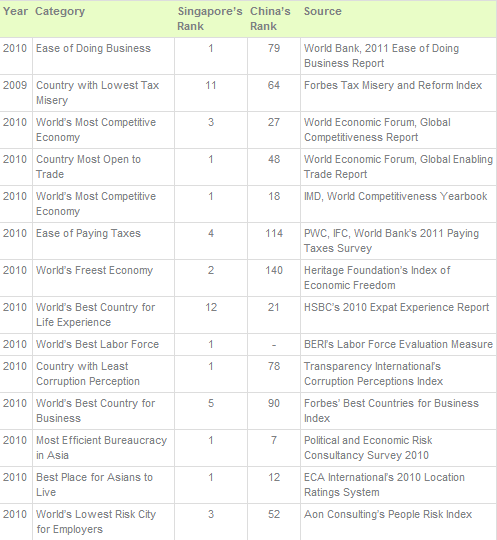
Why Chinese Officials Are In Love With The Singapore Model

In this article, Kyle Spencer explains why China is enamored with SG's economic and political model, but how the Chinese underestimate the task ahead of them of emulating SG (in part if not in whole, and if this is indeed their intent).

However, the reasons for China's interest in the Singapore Model makes for a compelling argument for Singapore as an investment interest, and Spencer makes this argument well.

Inevitably, there will be conspiracy theorists and Singapore bashers who seem to crawl out of the woodwork and trot out their pet conspiracy theories as to how Singapore succeeded (they need to justify to themselves why their own country is in the shits, despite having more natural resources, despite having more people, despite having more land, despite having history on their side).

Spencer was not interested in defending Singapore or Singapore's model, only his argument that Singapore is a good investment. So in the original article he has this to say:

Extract from:
http://seekingalpha.com/article/785611-why-chinese-officials-are-in-love-with-the-singapore-model

Corruption-Free

To hear the most enthusiastic of the pro-Singapore Chinese bureaucrats tell it, the only significant obstacle to adapting the Singapore Model to China is to stamp out corruption, and success will surely follow.

What the intelligentsia of the CPC fail to grasp is just how corrupt Singapore isn't. Transparency International ranks Singapore as the fifth least corrupt country in the world. By Singaporean standards, Germany, Japan, the United Kingdom, France and the United States are hopelessly and inexcusably corrupt.

China, on the other hand, is the 75th most corrupt nation. That means that China is more corrupt than Italy, about par with Columbia (sic), and only slightly less corrupt than Greece.

That's a long way to climb.

Singapore also offers protection for intellectual property rights, adhering to the WTO's TRIPS Agreement, the Berne Convention for the Protection of Literary and Artistic Works, and the Paris Convention for the Protection of Industrial Property. China is one of the world's most notorious offenders. In addition, Singapore holds the highest e-government ranking in the world.


Spencer's reply to the question in the comments, "Is Singapore a Corruption Haven for the billions of dollars parked there by corrupt Indonesians?" was this:
It's a matter of corruption chasing Singapore rather than Singapore chasing corruption.

"The global financial organization estimates that the amount of assets of Indonesian people in Singapore is S$87 billion, or around Rp506.8 trillion.

According to Teten, embezzlers prefer to deposit their funds in Singapore because they feel safe there although the origin of the funds is illegal.

The reason for this is that Singapore does not have a Money Laundering Law nor is it yet willing to sign an extradition agreement with Indonesia.

Through such an agreement, Indonesia can force Singapore to surrender bad debtors, including return of assets and funds.

Teten acknowledged that Indonesians also save funds in Singapore because of other factors, for example business.

This is because the business and investment climate in Singapore is very attractive.

"In addition, legal certainty is also good, far better compared to in Indonesia," he said."

http://bit.ly/Nz3u33

If you're corrupt, you don't want to park your money in a banana republic, because there's no honor among thieves. You'd want the just the opposite: an affluent, bustling international financial center that doesn't ask foreigners inconvenient questions.

Singapore is the world's fourth leading financial center, but its success as such isn't built on corruption, it's built on Singapore's maritime supremacy and ease of doing business. Singapore is the world's second-biggest casino gambling market, one of the world's top three oil refining centres, the  world's largest oil-rig producer, a major ship-repairer, and a top tourist destination. The port is one of the five busiest ports in the world. Singapore has the world's highest percentage of millionaires, with one out of every six households having at least one million US dollars in disposable wealth. This excludes property, businesses, and luxury goods, which if included would further increase the number of millionaires.

Now, that being said, it's prosperity is linked through its reliance on exports to the broader global market,
specifically America. Historically, Singapore is the first to go down in the event of an acute crisis, but its also the first to recover. See:

http://bloom.bg/Nz3u3b

http://buswk.co/NaQIMq

As always, due diligence is a must.

The article Spencer quoted (and linked) was from Oct 2006. In Dec 2010, SG's Deputy Prime Minister and Defence Minister visited Indonesia and spoke to students of Indonesia's Defence University. One of the question was about the extradition of corrupt officials.

In brief, the answer to the students was:

1) Corrupt Indonesians and corruption in Indonesia are an Indonesian problem to be solved by Indonesia. Singapore solved the corruption issue internally. We did not need extradition of corrupt officials, or money laundering laws to be enacted by other countries. Even if such laws and treaties were in place, without addressing the root cause of corruption, it simply means that the fruits of corruption will be channeled elsewhere.
2) Singapore is willing to help and had in fact agreed to an extradition and defence cooperation treaty. Indonesia's parliament has refused to ratify the treaty.
3) Where the Indonesian Courts have made a finding or judgement as to corruption and the funds involved and made a court order, the Singapore authorities have complied with such court orders.


Monday, August 6, 2012

Iron out flaws in MediShield first

Aug 03, 2012
 
PROPOSED COVERAGE FOR BABIES WITH BIRTH DEFECTS
 
By Salma Khalik Health Correspondent
 

THE birth of a child should be a joyous event. Unfortunately, this is not the case for all.

Between 2 per cent and 3 per cent of babies born each year in Singapore suffer from some congenital problems. Some conditions, such as a cleft palate or a club foot, merely need some initial treatment for the child to lead a completely normal life. Some others, like some congenital heart diseases, might require lifelong care.

The cost, even for a highly subsidised C class patient, can vary from a few hundred dollars to more than $100,000, which most people would find a heavy burden.

Everyone appears to agree that parents of such babies, and the people with such problems, should get help. What they disagree on is who should pay.

Is this something that society as a whole can help out with, should we all share the burden?

Since the subject was raised a few years ago, there have been discussions on whether MediShield, the national health insurance scheme that covers 93 per cent of the population, should cover congenital problems.

Those with a strong social conscience, or with personal or family experience of such problems, are vocal in its support.

Others, worried about the additional cost to them, argue that asking policy-holders to pay for the treatment of a known problem is unfair to the healthy. Instead, they view insurance as essentially pooling risks for potential problems that all are at equal risk of getting.

They argue that it should be the Government's job to look after such unfortunate people.

Given the polarisation of views, the idea of extending insurance coverage for neonatal and congenital diseases is clearly not one that the Health Ministry can push through without strong public support.

There are at least a few other reasons why some are wary.

As is obvious, the need for neonatal care is immediate and congenital problems are usually diagnosed within the first year of birth.

As MediShield is an opt-out scheme, there is nothing to stop parents of healthy babies from signing up at birth, and then opting out after the first year when they realise their baby does not need the coverage.

The Ministry has calculated that if the parents of children aged up to 20 years are fully behind it, then all each has to pay is an additional $12 a year. This means everyone needs to pay a total of $240 more - over a period of 20 years - to help out.

To some, this is part and parcel of being a caring society, to share the burden of paying for treatment for the stricken.

Others may view this as a forced subsidy they are unwilling to bear. Such people might decide to drop out of the scheme after a year or so, once they are confident that their child is not suffering from any congenital diseases.

If the group that drops out is large, it would push up premiums for those remaining on the scheme, which could lead to a domino effect of even fewer people wanting to be on it. Folk who are willing to pay $240 for coverage their family does not need, might baulk at $480, or more.

There is, however, a way out of this dilemma, and that is to load the premiums upfront in the baby's first year, or even better, from before the birth of the child.

That is when parents are still uncertain if their child has such diseases, and when they are likely to be willing to fork out the premiums for peace of mind.

At that point in time, most parents would be willing to pay high premiums of $200 or even more - especially as it can be taken from their Medisave accounts.

This means very little of the cost needs to be spread out among policy-holders up to the age of 20, making it less likely that they would drop out.

But the suggestion to cover neonatal and congenital problems with MediShield has another flaw.

This basic scheme is pegged at subsidised treatment at a public hospital. But more than half the babies born here are delivered in private hospitals.

If the baby is born premature, treatment will have to be at the place where the infant was born. If they are transferred to a public hospital, the child has to be a private patient.

A KK Women's and Children's Hospital spokesman said to downgrade to a subsidised ward, the parents have to be means tested. Is the payout from MediShield enough to pay for private treatment?

If not, it might defeat the purpose - unless the MOH is willing to change the current rule and allow any infant transferred from a private hospital to enjoy subsidised rates.

After several years of discussion, it would be a pity if Singapore is still unable to insure people born with congenital medical problems, or the several thousand born premature each year.


Sunday, August 5, 2012

People drive more when COE prices rise

Aug 02, 2012

ASK: NUS ECONOMISTS
The Sunk Cost Fallacy

  • The COE system has been in place for more than 20 years and yet the roads are still so crowded. Has it really been effective in controlling congestion?

LIKE many other cities, Singapore faces the challenge of managing traffic congestion. Since 1975, the Government has addressed the problem in two ways - pricing road usage and limiting the vehicle population. From 1990, the Government has explicitly limited the number of new car registrations to a monthly quota for Certificates of Entitlement (COEs).

At the last auction, the price of COEs (strictly, the COE quota premium) for large cars reached $90,501. COE prices have not been so high since late 1994. The result has been hand-wringing, howls of complaint and a torrent of letters to The Straits Times.

Quickly moving to assuage public concerns, Minister of Transport Lui Tuck Yew is talking of tweaking the system to moderate the inflation in COE prices. The latest change is to remove taxis from the bidding process for COEs in the small car category. Instead of bidding, taxis will pay the prevailing quota premium, and the quota will come from the Open category which can be used for any size of cars.

Yet, there seems to be little discussion of the more fundamental issue. Just how effective is the COE system in managing traffic congestion?

Tuesday, July 24, 2012

Getting real on saving for retirement

Jul 24, 2012
 
By Teresa Ghilarducci

I WORK on retirement policy, so friends often want to talk about their own retirement plans and prospects. While I am happy to have these conversations, my friends usually walk away feeling worse - for good reason.

Seventy-five per cent of Americans nearing retirement age in 2010 had less than US$30,000 (S$38,000) in their retirement accounts. The spectre of downward mobility in retirement is a looming reality for both middle- and higher-income workers. Almost half of middle-class workers, 49 per cent, will be poor or near poor in retirement, living on a food budget of about US$5 a day.

In my ad hoc retirement talks, I repeatedly hear about the 'guy'. He is a for-profit investment adviser, often described as, 'I have this guy who is pretty good, he always calls, doesn't push me into investments'. When I ask how much the 'guy' costs, or if the guy has fiduciary loyalty - to the client, not the firm - or if their investments do better than a standard low-fee benchmark, they inevitably do not know. After hearing about their magical guy, I ask about their 'number'.

To maintain living standards into old age, we need about 20 times our annual income in financial wealth. If at retirement you earn US$100,000, you need about US$2 million beyond what you will receive from Social Security. If you have an income-producing partner and a paid-off house, you need less. This number is startling in light of the stone-cold fact that most people aged 50 to 64 have nothing or next to nothing in retirement accounts and thus will rely solely on Social Security.

Even for those who know their 'number' and are prepared for retirement (it happens, rarely), these conversations are not easy.

At dinner one night, a friend told me how much he has in retirement assets and said he did not think he had saved enough. I mentally calculated his mortality, figured he would die sooner than he predicted, and told him cheerfully that he should not worry. ('Congratulations!') But dying early is not the basis of a retirement plan.

If we manage to accept our investments will likely not be enough, we usually enter another fantasy world - that of working longer. After all, people hear 70 is the new 50, and a recent report from Boston College says if people work until 70, they will most likely have enough to retire on.

Unfortunately, this ignores the reality that unemployment rates for those over 50 are rising faster than for any other group and that displaced older workers face a higher risk of long-term unemployment than their younger counterparts. If those workers ever do get rehired, it is not without taking at least a 25 per cent wage cut.

But the idea is tempting; people say they do not want to retire and feel useless. Professionals say they can keep going, 'maybe do some consulting' or find some other way to generate income well into their late 60s. Others say they can always be Walmart greeters. They rarely admit that many people retire earlier than they want because they are laid off or their spouse becomes sick.

Like the US wealth gap, the longevity gap has also widened. The chance to work into one's 70s primarily belongs to the most well- off. Medical technology has helped extend life - by helping older people survive longer with illnesses and by helping others stay active. The gains in longevity in the last two decades almost all went to people earning more than average.

It makes perfect sense for human beings to think each of us is special and can work forever. To admit you cannot, or might not be able to, is hard, and denial and magical thinking are underrated human coping devices in response to helplessness and fear.

So it is not surprising that denial dominates my dinner conversations, but it is irresponsible for Congress to deny that regardless of how much you throw 401(k) advertising, pension cuts, financial education and tax breaks at Americans, the retirement system simply defies human behaviour.

Basing a system on people voluntarily saving for 40 years and evaluating the relevant information for sound investment choices is like asking the family pet to dance on two legs.

Not yet convinced that failure is baked into the voluntary, self- directed, commercially run retirement plans system? Consider what would have to happen for it to work for you.

First, figure out when you and your spouse will be laid off or be too sick to work. Second, figure out when you will die. Third, understand that you need to save 7 per cent of every dollar you earn. (Didn't start doing that when you were 25 and you are 55 now? Just save 30 per cent of every dollar.) Fourth, earn at least 3 per cent above inflation on your investments, every year. (Easy. Just find the best funds for the lowest price and have them optimally allocated.) Fifth, do not withdraw any funds when you lose your job, have a health problem, get divorced, buy a house or send a kid to college. Sixth, time your retirement account withdrawals so the last cent is spent the day you die.

As we all know, these abilities are not common for our species.

The current model for retirement savings, which forces individuals to figure out a plan for their retirement years - whether through a 'guy' or by individual decision making - will always fall short. My friends are afraid, and they are not alone. In March, according to the Employee Benefit Research Institute, only 52 per cent of Americans expressed confidence that they will be comfortable in retirement. Twenty years ago, that figure was close to 75 per cent.

I hope that fear can make us all get real. The coming retirement income security crisis is a shared problem; it is not caused by a set of isolated individual behaviours.

My plan calls for a way out that would create guaranteed retirement accounts on top of Social Security. These accounts would be required, professionally managed, come with a guaranteed rate of return and pay out annuities. This is a sensible way to get people to prepare for the future.

You do not like mandates? Get real. Just as a voluntary Social Security system would have been a disaster, a voluntary retirement account plan is a disaster.

It is now more than 30 years since the 401(k)/Individual Retirement Account model appeared on the scene. This do-it-yourself pension system has failed. It has failed because it expects individuals without investment expertise to reap the same results as professional investors and money managers. What results would you expect if you were asked to pull your own teeth or do your own electrical wiring?

Although humans may be bad at some behaviours, we are good at others, including coming together and finding common solutions that protect all of us from risk. Surely we can find a way to help people save - adequately and with little risk - for their old age.

The writer is a professor of economics at the New School for Social Research in New York City.

NEW YORK TIMES SYNDICATE

[Before we congratulate ourselves on having CPF and a minimum sum in our retirement accounts, most Singaporeans are also not adequately prepared for retirement. Maybe we are not as badly off, but we are hardly living the good life either.]
 

Saturday, July 21, 2012

4 (very powerful) friends

Jul 21, 2012

Helmut Schmidt, Lee Kuan Yew, Henry Kissinger, George Shultz are slowly saying farewell 40 years on

By Matthias Nass

ONCE they were powerful. Dreaded. Admired by many, hated by some. Their lives are coming to an end. Yet, there is still one story to tell, the story of a friendship.

It is about four men who cannot be more unemotional.

Helmut Schmidt, Lee Kuan Yew, Henry Kissinger and George Shultz: cool, if not cold, power-hungry politicians.

Yet, for more than 40 years, their friendship has been close, almost intimate. Now they are slowly saying their farewells to each other.

Singapore, at the beginning of May, conference room 'White Magnolia' at Shangri-La Hotel...

Schmidt wanted to meet Lee, the founding prime minister of the Asian metropolis, for the last time.

He has not looked forward to a trip for a long time as much as this one to see 'Harry', how Lee has been called among his friends since he was a student at Cambridge in England. From Singapore, Schmidt will be travelling to China for five days, also a long-cherished wish.

Schmidt is 93. Who would still go on a 15-hour trip from chilly Hamburg to hot and humid Singapore at that age? In March, his doctors gave the green light: The thrombosis he is suffering from does not prevent him from flying.

Lee, 89 years old, wrote to him to say how happy he was about the visit. Also, that his friend would need some rest after arrival, at least one night, to overcome the jet lag. The next evening, he would invite him to dinner.

Afterwards, they want to sit down together on three afternoons, to talk with each other. About China, America, Europe - the big picture, the way they always used to do.

A book shall be produced, a collection of their conversations on the world's situation. Neither would accept anything less.

And then the conversation begins very softly. 'My wife passed away and left me at the age of 91,' says Schmidt. 'Loki died at 91?' - 'Yes, it was a big loss. Must be the same for you.' - 'Yes, it creates a deep hole in our life; nothing can fill it.'

Three weeks before Loki Schmidt's death, at the beginning of October 2010, Lee's wife Choo died.

As students at Cambridge, the two Lees stood out intellectually. Driven by ambition, they returned to Singapore. Lee established an educational dictatorship there which, despite all its successes, was feared.

Lee could be merciless. He persecuted political opponents, sent them to their financial ruin with lawsuits, gagged the press.

But when his seriously ill wife had been bound to bed unable to talk or move for more than two years, he came to sit next to her and read to her every night. He wanted her to die in peace. They were married for 64 years.

'We were married for 68,' says Schmidt. 'We had hoped to stay together for 70 years,' he says. 'Yeah,' sighs Lee with a hoarse voice. 'Yeah.'

Schmidt is sitting in a wheelchair on Lee's right; he can hear only with his left ear. Lee is sitting upright. He is wearing a dark blue Chinese silk jacket, and with his almost bald head, he appears like an aloof Beijing mandarin.

Lee formulates articulately, in Oxford English full of nuances. In front of him stands a glass of hot water, but he does not take even one sip during the conversation.

Schmidt is not allowed to smoke for hours, a torture to him. Lee, in the past a heavy smoker himself, is now allergic to cigarette smoke.

Once, absorbed in thought, Schmidt reaches into the left pocket of his jacket, pulls out a box of cigarettes, lights a Reyno. Lee is going stiff, not saying anything, just looking at Schmidt, who is suddenly startled: Where is the ashtray? There is none.

He hesitates and flings the cigarette with verve into a deep coffee cup. Great hilarity!

'For me, this is a sentimental journey,' Schmidt says, picking up the thread again. He had been in Singapore for the first time in 1958 or 1959, had stayed at the famous Raffles Hotel back then. 'The old colonial officers pretended to drink tea but drank whisky instead!'

Schmidt abruptly switches to politics, wants to know when Lee met Deng Xiaoping for the first time. It was in 1978, Lee replies, two years after the death of Mao Zedong, when Vice-Premier Deng began the economic transformation of the giant country.

Lee believes that Singapore was Deng's example. A free market and a strong government - that's what he learnt from Singapore.

It was also in 1978 that Schmidt and Lee met for the first time. Lee does not recall their first meeting. Schmidt's recollection of that day is more vivid. He had come from Japan and had stopped in Singapore on the way back, Schmidt says. Lee showed Loki the Botanic Gardens, and she was very impressed.

Mr Olaf Ihlau, correspondent of Suddeutsche Zeitung at the time, wrote about Lee's and Schmidt's first meeting: 'Both politicians are very alike. They are men of action and pragmatists, experts on economic matters and are against ideological reveries.

'Both are of great intelligence prone to impatience, and find it difficult to control their sense of superiority. The head of the South-east Asian island of prosperity has stopped appearing at press conferences a long time ago, where he had to answer possibly annoying questions.

'Lee considers journalists to be 'crackpots'. Another stance that is probably not that far removed from Helmut Schmidt's.'

Back in those years, nobody, not even the crackpots, could deny that Singapore was blossoming. After separating from Malaysia, Lee was pushing the former outpost of the British Empire with an iron hand into modern times.

George Shultz also became interested in the South-east Asian economic miracle. On his way to an Asian summit meeting, America's then Treasury Secretary stopped in Singapore in 1972.

Forty years later, Shultz talks about this visit while we are sitting at the Adlon Hotel in Berlin.

It is May 24, and later that evening, he will receive the Henry Kissinger Award of the American Academy. Kissinger is also in town. And so is Schmidt, who will deliver the laudatory speech for Shultz.

One is missing. Lee was not able to join them last autumn, when Schmidt, Shultz and Kissinger met in New York.

Shultz remembers how both Lees proudly showed him their city, and how he told Kissinger about it after his return. 'It is very rewarding to talk to Lee, I said to Henry, who already knew him. We understand each other.'

Shultz is the great organiser; he was the one who brought all four together for the first time. That was in 1982.

Schmidt was still Federal Chancellor of Germany, and Shultz was just named Secretary of State by Ronald Reagan.

Shultz brought Schmidt along as his guest to 'Bohemian Grove', a kind of summer camp for America's economic and political elite in California, with lots of drinking, bawdy jokes, and little talk about politics and business.

Kissinger invited Lee, Shultz says. After the camp, they drove to Shultz's house on the campus of Stanford University for lunch. 'All four of us sat around my kitchen table and talked for two, three hours, until my wife and Choo (Mrs Lee) asked us to get up so they could prepare lunch. I was thinking to myself: What a great lesson for a new secretary of state!'

Lee remembers how Schmidt sat down at the piano and 'professionally played classical pieces without any sheet music'. The four were smitten with each other. This was the beginning of a friendship that still lasts today.

At that point, Schmidt and Shultz had already known each other for 10 years. They met at the 'Library Group' in 1972. In the wake of the annual meetings of the World Bank and the International Monetary Fund (IMF), he wanted to meet the most important finance ministers in Washington, Shultz recalls.

'Of course, Helmut was one of them.' He invited Schmidt, France's Valery Giscard d'Estaing, Britain's Tony Barber, and, later, Japan's Takeo Fukuda to a discussion over lunch.

'I told the President about this. Nixon said: Good idea! Why don't you add some style to the meeting and hold it at the White House? So we went to the library of the White House - a wonderful room. Great food! And it worked.

'We met again, we could talk on the phone, and it all led to mutual trust. Somebody then suggested to call our circle the 'Library Group'.'

And it would become even more. During the meetings at the library of the White House, the idea of the Group of Seven summits was born.

Of course, Kissinger and Shultz had known of each other before. Both had a career at university. Kissinger at Harvard, and Shultz just a couple of kilometres away at the Massachusetts Institute of Technology (MIT). One is a historian and political scientist; the other an economist. 'I didn't know him personally,' Shultz says, 'but I knew of him.' 'Because what he said had a high public profile.'

Richard Nixon brought the two of them together. Kissinger became National Security Adviser to the President, and later Secretary of State. Shultz was Secretary of Labour, then Treasury Secretary.

Have they ever been rivals?

'No,' Shultz says. They complemented each other. He, for instance, provided a study about the American dependence on oil imports, Shultz adds, while Kissinger was thinking about the strategic implications.

Even after their time under Nixon, they remained in touch. When Shultz himself became Secretary of State, he sought the advice of his friend and predecessor.

In old age, both Republicans have lent their authority to an astounding nuclear disarmament initiative: 'Global Zero' - total nuclear disarmament!

However, Schmidt does see some differences between the two. 'Shultz is convinced about the need for nuclear disarmament; Henry is more reserved.' With regard to nuclear matters, Kissinger is 'the most rational and realistic'. 'He exaggerates realism a bit, as I see it.' And Schmidt's own view? 'Almost entirely on Shultz's side.'

Why is there this surprising change of mind on nuclear policy matters by the former nuclear strategists? 'It was not a sudden change,' Schmidt explains. 'It was a slow development. I have always considered nuclear rearmament to be exaggerated.'

And nevertheless: The change of mind cannot be denied. And there are good reasons for this.

The former Cold Warriors had realised that a 'balance of terror' will only succeed between the high performance military of developed industrial nations, and that their cold instrumental rationality was only able to keep the peace through a stroke of luck.

They believe that in these times of unpredictable nations such as Iran and North Korea, or even terrorist groups striving for the bomb, it is no longer possible to rely on the stability of mutual deterrence.

Of course there are differences between the four when it comes to political issues. 'A great point of disagreement: Possibly opposed to Lee and definitely to Henry, I consider the American maritime nuclear deployment towards China to be quite exaggerated,' says Schmidt.

China! All four of them take a passionate interest in China's rise to its former greatness. Naturally, Schmidt has read Kissinger's new book On China. 'Something is missing. Too much Kissinger, too little China. The book could be called 'On Henry'! Overall, however, it displays great respect towards Chinese civilisation. Germans often mix up civilisation and culture!'

Kissinger and Schmidt first met at 1950s end. Where and how exactly - at Harvard or at the America House in Hamburg - is disputed between the two.

Kissinger likes to tell the story about how he, before their first meeting, confused Schmidt, introduced to him as an 'up-and-coming politician', with Carlo Schmid, one of the fathers of the German Basic Law. 'This was the more important German I knew.'

More than half a century has passed since then, and the dialogue between the two has never stopped. Schmidt explains that they obviously did not always agree when they were still both in office, Schmidt as Federal Chancellor, and Kissinger as National Security Adviser and Secretary of State.

During the East-West negotiations in the 1970s, for instance, 'Kissinger was much more sceptical about the closing meeting in Helsinki than me and his boss, Jerry Ford'. They also had opposing views when it came to the Vietnam War: 'He wanted to end the war, but much too slow. I wanted to speed it up.'

Were Chile and Cambodia an issue between the two, the overthrow of Allende by Pinochet and the bombardment of Vietnam's neutral neighbour by the Americans? 'Neither Cambodia nor Chile played a big role between us,' Schmidt replies, 'while I have always assumed, but never knew, that Henry was burdened.'

What lies at the core of this friendship?

'Human dependability,' Kissinger replies. 'I know when Helmut needs to talk, even when he would never ask for it. I know, on the other hand, that he would be there if I needed him.'

However, don't they say that friendships cannot exist in politics, we ask Helmut Schmidt.

'Yes, this is a mistake!' he grumbles. 'These four people can be sure that one of them does not say anything but what he considers to be his truth.'

'What he considers to be his truth,' Schmidt repeats. 'What you say in public may differ in some cases.'

Isn't there more: Are they not all typical political realists? Well, Schmidt says, 'more influenced by realism than by ideology, that is true for all four of us'. But he does not like the term political realist. 'We would have never used such a term! Why should we stick a label on us?'

Realists and internationalists at the same time. 'We do not think nationally when it comes to issues that affect all of us,' says Kissinger. 'It's about real global issues after all, so we discuss them from a global perspective.' Schmidt calls Kissinger, the Jew who fled Germany with his family in 1938, an 'American global citizen'.

'I have many friends,' Kissinger continues, 'but I would say that I always end up with these four. Most people do not even know this group exists. In this sense, it's exclusive.'

Our meeting in the afternoon before the award ceremony is short. Kissinger wants to go over to Helmut Schmidt's office next to the Reichstag. But he wants to know one more thing before he leaves: What did Lee say when we met him in Singapore? What does he think about the friendship of the four?

Lee also talked about trust and added: 'Our minds work in similar ways.' He talks on the phone with Kissinger at least once every two months, he said. They mostly talk about China or about other current major political issues. And one other thing: 'Henry called to console me when my wife Choo passed away.' This touched him.

Yes, says Kissinger: 'I called him almost every day back then.' Because in Lee's culture, it is very difficult to express personal grief, he adds. Was he able to console his friend? 'I think, he was consoled by being able to talk about Choo - so yes.'

At the end of life, when the final balance sheet is drawn up, one thing remains: friendship, partnership, love. 'If my former wife was still alive, we would be married for almost 70 years now,' George Shultz says. She died 16 years ago from cancer. The (former) husband of his current wife Charlotte also died from cancer. 'So we got married,' says Shultz.

A radiant Charlotte Shultz enters the room during our meeting in Berlin. She was Head of Protocol of California under Governor Arnold Schwarzenegger.

The wives, says Helmut Schmidt, played 'a certain role' in the friendship of the four. Nancy Kissinger is 'a politically interested and intelligent woman who is reserved when expressing her views'. 'The second Mrs Shultz likes to talk, as she is full of impulses.'

The atmosphere is completely different when the wives are present, but they are also talking politics. What else are they talking about? 'About age, old age dementia, about the world, and about Dear God!'

Just as last year in New York. They met at the Waldorf Astoria. 'There were two different meetings,' says Helmut Schmidt. 'One for several hours with just Shultz, Kissinger, and Schmidt. And then a dinner with all three and the two wives - Mrs Shultz and Nancy.' It was his trip to say goodbye to America. Schmidt happily takes another drag from his cigarette: 'But I'm still alive!'

Another trip to America? 'No!' And if a friend needs him? 'I wouldn't rule it out completely, but I have no plans to do so.' He is determined to not make any more big trips. 'Within Europe - that is something else. Or Moscow, that is also something else.'

So Moscow would be tempting? 'Yes.' Are there any plans? 'No, nothing is planned.'

How to go about plans when you are getting older? - This is what we ask Kissinger. 'You have to choose. The things you can do are limited. So you should be doing things that are important and rewarding. Therefore, each one of our meetings is something special.'

Of course, it is important that we see each other, Kissinger adds. 'But there is nothing left we need to tell each other. Nothing will remain unfulfilled because of it. Nevertheless, the loss will be great when one of us passes.'

The critical interest in each other is still alive, the constant curiosity. George Shultz says: 'Every once in a while, Helmut sends me one of his speeches. I always read it very thoroughly. And then I read it again.

'It usually includes some subtleties you have to search for. He is a careful thinker. But he knows how to think big. Most people say utter nonsense when they are thinking big. When Helmut thinks big, it has meaning.'

And so they continue working. And they impress the people around them with their presence and creative power. At this warm evening in May in Berlin, they are sitting next to each other on the podium of the 'Weltsaal' (World Room) of the Federal Foreign Office: George Shultz, 91, Helmut Schmidt, 93, and Henry Kissinger, 89. There is not one person in the room who can withdraw from this touching moment.

All three have made history. They comfortably scan the rows in front of them: Shultz, sitting proud and straight with a crimson bow tie; Kissinger, slumped and with a wavering gaze; and between the two, Schmidt in his wheelchair, his hands without cigarettes on his lap.

They are well aware of their aura, and enjoy it with the kind of ironic distance of people who have seen too much to take every praise seriously. And who, nevertheless, always enjoy hearing it! You can put on a grim expression. Or grumble a bit. There is nothing that delights people more.

Schmidt, who delivers the laudatory speech for awardee Shultz, remembers Franklin Roosevelt, Harry Truman, George Kennan, George Marshall, Eisenhower, and Kennedy. 'George, you are one of the American leaders that established the friendship with the Germans - after two world wars, in which we Germans were your enemies. And for this, I will forever be your thankful friend.'

The brief moment together in an adjoining room before the award ceremony is more important to the three than the actual event itself. This is what they were looking forward to. This is why they have travelled from Hamburg, New York, and San Francisco.

And this is why Schmidt flew to Singapore one last time.

'This is my last visit to this part of the world,' he said at the end of the third day. 'All the best to you, Harry.' - 'For you too,' Lee replies, and his voice is coarse. 'It was an honour to have known you.' They lean towards each other and hug. Very carefully.

For a moment everything is quiet in the room. Then Schmidt calls for his bodyguards. 'Wheel me out of here!'

The writer is the Chief International Correspondent of the German weekly Die Zeit. The article first appeared in German in the July 5, 2012 edition of Zeit Magazin, the magazine supplement of Die Zeit.