Saturday, August 18, 2012

How should the Government handle rumours?


In the lead-up to the country's birthday this month, the talk of
the town - and even across the Causeway - was about the "news" that
wasn't.


A rumour that former Minister Mentor Lee Kuan Yew
had died started circulating on Twitter at least five days before the
National Day Parade, with journalists asked by just about everyone -
friends, parents, the neighbourhood barber - about its veracity. And
despite a couple of journalists' efforts to debunk the rumour online, it
continued to spread, spilling over into the heartlands via word of
mouth and SMSes.

It reportedly generated some of the most
searched terms on Google during that period, and was rolling off the
tongues of housewives and taxi drivers as well. Internet chatter became
coffee shop talk.

This is not the first time that rumours
have circulated about the health of one of Singapore's founding fathers
and former Prime Minister. But never before, it is fair to say, had the
speculation spread so virulently, quickly and widely.

In
an age where more than one in two Singapore residents is ostensibly on
Facebook - that's 2,712,060 users here - social media has become the
megaphone that amplifies rumours exponentially.

So what has
been puzzling to many was the radio silence during the week from the
Government, which in the past has found ways, direct or otherwise, to
dispel such misinformation.

POTENTIAL FOR MISCHIEF


The hoax, of course, was laid to rest when Mr Lee turned up at the
parade in good health - an image simultaneously beamed to television
sets across the island. Within a mere couple of hours, the Instagram
image posted on TODAY's Facebook page had been shared tens of thousands
of times, and commented on excitedly.

The incident provides
much to chew on, including how it demonstrated a widespread belief,
misguided or otherwise, among Singaporeans that the Government would
withhold important information for expediency.

Just as
important, well-educated Singapore society - as a whole, as well as at
the individual level - was found wanting in its ready credulity. A
society susceptible to rumours is an easy target for any troublemaker,
with the new media as an accomplice.

A case in point: In
India on Thursday, thousands from the north-east of the country fled
southern cities after rumours they would be attacked by Muslims in
reprisal for recent ethnic violence. Bangalore Deputy Commissioner of
Police Vincent S D'Souza told AFP: "Mischief-mongers and vested
interests are misusing social media, mobile and the Internet to spread
these rumours and create panic."

In business, listed
companies pro-actively and regularly rebut rumours. In politics,
election campaigns are won or lost on the basis of how well untruths are
debunked.

So why did the state machinery - which recently
added a Chief of Government Communications to its ranks - not rebut the
rumour about Mr Lee's health?

IN PAST INSTANCES


Granted, there is the risk that addressing rumours (which breed
effortlessly in cyberpace) ends up lending them credence, and encourages
even more rumour-mongering, not to mention a public expectation that
the Government will rebut every untruth - failing which, the assumption
is "it must be true".

The Government's long-held stance is
that it does not deal in rumours. But surely, given how this particular
rumour gained traction and created protracted public anxiety, some sort
of response - not necessarily an official one - was merited?


A distinction should also be made between disinformation and
misinformation. While the latter would eventually die out,
disinformation - driven by malicious intent - is harder to quash and
should be nipped in the bud.

In 2010, a former Singaporean
claimed on his blog that Mr Lee had suffered a massive heart attack and
was slammed by netizens for what he quickly admitted was a hoax.


The Government had declined comment, but a routine and unrelated
statement was triggered by Mr Lee's visit (as Minister Mentor) to London
at the time.

Today, Mr Lee does not hold any Cabinet
position. It may, or may not, have been a factor in why it was felt
unnecessary to officially rebut the rumour. But is this not where the
Government's social media strategy should have come into play?

MPS: NO NEED TO REBUT


A number of People's Action Party MPs and Cabinet ministers have
been cultivating an active presence on Twitter and Facebook. A simple,
by-the-way tweet or post from any of them could have stopped the rumour
in its tracks. Instead, the silence fuelled the speculation.


At its height, there were comments circulating which were attributed
to Tanjong Pagar GRC MP Chia Shi Lu. The problem was that Dr Chia's
comments - stating that Mr Lee was in good health when he met him on
April 9 - were made months earlier in response to the rumour mill then.
That fact did not stop websites and online forums from perpetuating Dr
Chia's remarks as if they were recently made, as a result of which,
netizens not only gave Dr Chia grief, they also found more reason to
believe the hearsay.

MPs that TODAY spoke to explained that
they saw no need to rebut the latest falsehood about Mr Lee's health
given that the National Day Parade was just a few days away. Some, like
MPs Denise Phua and Zaqy Mohamad and Acting Manpower Minister Tan
Chuan-Jin, only alluded to the rumours after the event.

"Mr
Lee's appearance would have been the best response," said Mr Tan, who
had reposted TODAY's picture of Mr Lee on his Facebook page on National
Day.

Tampines GRC MP Baey Yam Keng said: "To be honest, I
didn't have the information - we don't come in contact with him on a
daily basis. In the past there have been other rumours, we can't be
checking on his health every time. In future, there could be rumours
again. So if the MPs respond to this one, but don't respond to future
rumours, then people may think something is amiss."

BE DISCERNING


Mr Baey, a public relations practitioner, said had there not been
an opportunity for Mr Lee to make a public appearance, and had the
rumour continued, then MPs could take steps. For instance, "if there had
been a grassroots event where we saw him, we could then casually post
on Facebook. Such a subtle note would be better".

What
about the mainstream media, one might ask. To some extent it was faced
with a similar dilemma: Should it devote column space to debunk every
rumour floating around? This paper's position is that we will address
those that have a wide-ranging effect on the whole of society. But for
us to do that, the stakeholders have to give the media something to
debunk the rumour with.

Yet it is also important that the
Government - when grappling with disinformation, rumours, untruths,
myths and smears - not go overboard, either, in feeling compelled to
respond regularly and with equal weightage to every nugget. Nuance is
key.

As both Mr Baey and Mr Tan point out, ultimately, it
is a judgement call whether a rumour warrants a response, "and if so, in
what form", as Mr Tan put it.

"If it has a severe impact
on national interests, there would be a need to respond as quickly as
possible … especially when it has the possibility of viralling out of
control and spilling over into real actions.

"For example, race and religious issues," said Mr Tan.


"The important thing is for readers to realise that not everything
is as it seems, and the spirit of discernment is critical."

Hopefully, the education process - on both sides - is underway, thanks to an episode that will serve as a cautionary tale.

A Chinese murder mystery, far from solved

Aug 17, 2012


LAST Thursday's hastily orchestrated murder trial of Gu Kailai, the
wife of ousted Chinese Politburo member Bo Xilai, has raised several
questions that cast serious doubt on the case.


It appears that the trial, which lasted less than eight hours, was a
sham and Gu was made a scapegoat in a broader political power struggle
between her husband and top leaders like Premier Wen Jiabao and
President Hu Jintao.


During the trial, Gu confessed to murdering her British business
partner, Mr Neil Heywood; she said she was willing to "accept and calmly
face sentencing" and that she expected the court to give her a "fair
and just verdict".


After combing through leaked court proceedings and official news
reports and interviewing two of the 140 people carefully selected by the
Chinese government to attend the trial, I have identified a dozen
important legal problems that were ignored or omitted during the trial
and that might have resulted in either a dismissal of charges or
acquittal, if the defence had been allowed to address them properly.


  • Gu had been officially given a diagnosis of manic depression and
    moderate schizophrenia by court-appointed medical experts. The
    indictment is largely based on her confession. Without any corroborating
    witness accounts, how do we know her memory was reliable and that her
    mental illness did not affect criminal intent?
  • The motivation for the murder was not clear. The prosecution stated
    that Gu hatched the plot to kill Mr Heywood when she was told that he
    had detained and kidnapped her son in Britain after their business deal
    soured.

The only evidence shown in court was an early November e-mail from Mr
Heywood, who wrote to Gu's son, Mr Bo Guagua: "You will be destroyed."


But by then, her son was already in the United States, studying at Harvard.


  • The indictment said that Gu had illegally obtained rat poison. Is
    there proof that she actually did? From whom did she get it? And did the
    rat poison contain cyanide?
  • Was there cyanide in Mr Heywood's body? Gu admitted getting him
    drunk and then giving him water laced with cyanide after getting him
    drunk.

However, the initial forensic report, according to the defence,
displayed no primary signs of cyanide poisoning. A CT scan performed on
the victim's body before it was cremated and an initial blood test found
no traces of cyanide.


  • According to Gu's defence, Mr Heywood had a family history of
    cardiovascular disease. Since he was not a heavy drinker, could it be
    possible that he died naturally of a heart attack induced by excessive
    drinking?
  • According to the prosecution, the chief investigator took another
    blood sample, which later became a crucial piece of evidence after Mr
    Heywood's body had been cremated. However, the chief investigator
    carried that blood sample home without permission.

Four months later, tests on the second blood sample showed cyanide,
the amount of which was, by coincidence, just enough to kill a person.
Is there any evidence that the integrity of that blood sample was
safeguarded during that four-month period?


  • Was there a struggle before Mr Heywood's death? Gu said that he was
    dead before she left the room, his head resting on a pillow. When the
    police discovered Mr Heywood's body two days later, however, he was
    lying flat on the bed, and the mattress showed signs of having been
    rolled on.

Considering this evidence, a criminal expert I interviewed believes
that Mr Heywood was probably not killed by cyanide, which tends to kill
quickly, or there was not sufficient poison to kill him right away and
that he was actually still alive when Gu left the room.


  • According to the defence, after Gu left the crime scene, strangers'
    footprints were found on the balcony, but there were no signs of a
    break-in. Why has the court not investigated where these footprints came
    from?
  • The prosecution claimed to have collected 394 witness testimonies,
    but the trial was conducted without the direct participation and
    cross-examinations of key witnesses, including Chongqing police chief
    Wang Lijun, who fled to the US consulate there and personally brought
    the case to light.

Gu picked her defence lawyer from a list provided by the government a
month before the trial. For such an important case, why was the lawyer
given only a short period of time to study the case? And why didn't the
defence lawyer have a chance to question key witnesses during the trial?


  • There was no explicit mention of Gu's husband in the indictment.
    When Gu learnt that Mr Heywood was threatening her son, wouldn't she
    tell her husband, the local party boss? Was Bo Xilai involved in the
    plotting of the murder?
  • After the Chongqing police had ruled that Mr Heywood died of a heart
    attack from excessive alcohol consumption, Gu successfully persuaded
    the Heywood family to agree to a quick cremation without an autopsy. Did
    Gu or the Chongqing government pay money in exchange for the family's
    silence?
  • The indictment pointed out that Gu and Heywood teamed up in 2005
    with a senior manager at a Chinese state-run enterprise in several real
    estate deals in Chongqing and in France.

If successful, Mr Heywood would have been awarded £40 million. But
the deals fell apart. Mr Heywood demanded 10 per cent of the original
amount as compensation.


There were no explanations of what the projects were, why the deal failed and what Mr Heywood's role was.


According to a source in Beijing, Bo Xilai, who was transferred to
Chongqing in 2007, halted the projects for fear that the deals could
jeopardise his political future. If that proves to be true, could it be
that the prosecution hid these details, which might contradict claims by
the government-controlled media that he was a corrupt official?


Gu and her family may have intentionally refrained from mounting a
vigorous defence against the murder charges and decided to strike a deal
with the government because she understood that the trial's real target
was her husband - whom senior party leaders in Beijing are hoping to
render guilty by association and destroy for good.


If she had fought against the murder charges, the Bo family's
political foes would have initiated corruption charges, which could also
be punishable by death. In China today, corruption is so rampant that
no government official is immune, and if such charges were made, her
son, her husband and many of her friends could be implicated. Between
the two, perhaps the murder charge seemed the better deal.


By actively cooperating with the government - she confessed to the
crime and implicated the police chief and his assistants - Gu aimed to
get her potential death sentence commuted.


As the Chinese saying goes, "as long as the green hills last, there
will always be wood to feed the stove". In Gu's case, keeping her life
and shielding her husband from criminal prosecution leaves open the
possibility of a comeback when the political winds shift.


Gu's father-in-law, Mr Bo Yibo, was branded a traitor during the
Cultural Revolution, beaten, paraded around and locked up in a prison
where he was often deprived of food and water. Three years after Mao
Zedong died, the case against him was overturned. He was reinstated by
the new leadership as the vice-premier of China and lived to age 99,
outliving most of his foes.


Given the complexities of the case and the tremendous amount of media
attention, one would have assumed that the Chinese government would
take the case seriously or at least attempt to honour due process.


Unfortunately, the trial was conducted hastily and shabbily, exposing
the ugliness of the Chinese legal system. One can only imagine the fate
of the thousands of faceless or nameless Chinese who are being judged
by the legal system without any media attention.


Gu's verdict will be decided by party leaders in Beijing, rather than
judges in court. Rushing to justify the ousting of Bo Xilai, who was a
strong contender for a spot on the powerful Politburo Standing
Committee, helps leaders in Beijing clear a major hurdle before the
leadership transition at the 18th Party Congress later this year.


Therefore, the Chinese government will most likely give Gu a harsh
sentence. But the fundamental legal questions have not even been asked,
let alone answered.


Ho Pin, a New York-based publisher of Chinese-language
magazines and books, is the author of a forthcoming book on the Bo Xilai
case. This essay was translated by Wenguang Huang from the Chinese.


NEW YORK TIMES SYNDICATE

Monday, August 13, 2012

Why I love this neurotic small country

Aug 13, 2012
 
By Joyce Hooi
 

WHEN you are growing up, you are told a series of well-intentioned lies. "You can be anything you want to be" being the biggest porky. The jet-setting cosmopolitan child is also lied to. "You are a citizen of the world," he or she hears.

I found out very quickly that you are a citizen of two or three places at most - the country you have the fortune (or lack thereof) to be born in, and the ones that you choose for yourself if you're lucky.

Last year, I chose Singapore and six months after my citizenship application, Singapore chose me back. The first time I thought seriously about becoming a Singaporean was five years ago. A permanent resident then, I was watching a local news bulletin with the growing fascination people reserve for train wrecks.

If memory serves me right, some outraged residents of an estate had found that roadworks nearby were causing cracks in their driveway tiles. A female resident said: "The rainwater is pooling in the cracks and my maid might get bitten by mosquitoes when she's washing my car and get dengue," or something to that effect.

I'd thought, by gum, I want to be this lady. I want her First- World problems and maybe-dengue. Where I'm from, people simply have problems and actual dengue.

I would not insult anyone with a spiel about how this is the Greatest Country on Earth. Countries like America have genuinely believed that and look what's happened. Singapore, like any other country, is not for everyone. I have honestly never seen a nation of people more hard on itself despite achievements of dazzling proportions against the worst of odds.

After a look at Gardens by the Bay - one of the most spectacular feats of planning and thoughtfulness I have seen - a friend asked me with the furrowed-brow earnestness only a local could muster: "Do you think it's too contrived?"

Singapore is the Woody Allen of nations - simultaneously brilliant and self-flagellating about not being brilliant enough. Singapore is also like the father in the High Expectations Asian Father meme who says things like, "B is for Burger King... where you are going to work for the rest of your life" and "You are the 99 per cent? Why not 100 per cent?"

I say this with the utmost of affection. In fact, these national quirks are why I am now a Singaporean.

For once we stop complaining about the smallest of things and sending our five-year-olds to two kindergartens at once, we will become... Europe.

When Orchard Road flooded last year, national outrage abounded but where I was born, you don't need rain to wipe out years of industry. The house of your existence, built painstakingly by hard work, artful dodging of the law and gritted teeth, can be washed away overnight by the caprice of someone powerful, greedy or stupid.

Over here, the refrain when anything goes wrong is: "How could the Government let this happen?" while in almost everywhere else, the government is something that happens to you if you're unlucky. You could enter a building through the door for questioning but leave via the window, under a white sheet.

I came to Singapore nine years ago. Since then, people have given me scholarships, written me letters of recommendation and let me do a job that I love. They saw me not as competition but as someone in need of the opportunities that her home country could not or would not give her, and for that I am eternally grateful.

It is a lie that you are a citizen of the world. You are a citizen of the country from which your space has been gradually chiselled and negotiated with the other people who share it. With the current zero-sum talk about crowded trains and high property prices, this might seem a daunting feat, but it can be done. We've been doing it for 47 years.

This article appeared in The Business Times on Aug 9.

It's OK that Singaporeans not really into sports

Aug 12, 2012
 
By Rachel Chang
 

Singapore's first individual Olympic medal in 50 years seems to have ignited some sort of national identity crisis.

The victorious high over Feng Tianwei's bronze in table-tennis has ebbed rapidly into complex disconcerting topics like what it is to be a real Singaporean.

I think it's an equal-opportunity wariness applied to all "new" immigrants. I mean, if Eduardo Saverin invents a better Facebook, no one would really swallow the headline "Singaporean Website Changes Face of Social Media" either.

Implicit behind all the hue and cry is perhaps the acknowledgement (admission?) that a born-and-bred Singaporean could not have reached the heights of sporting achievement that Feng did.

Maybe it's that - and not the haircut or the accent - that makes her not seem like a real Singaporean because let's face it, this country fits with sporting achievement about as well as it does with cold weather.

It's not the small population size that constrains us. Look at Jamaica, with 2.8 million people and 10 medals. Nobody there is going on about how there's not enough talent for two "A" teams.

Sporting achievement seems to me to be a function of two things: innate ability and obsessive drive.

Assuming that the first is randomly sprinkled throughout the world's population such as albinos and midgets, then it's in the latter where we are falling short.

By obsessive drive, I mean the no- childhood, practise 15-hours-day, strict- calorie-control, no-interests-outside-of- sporting-area type of obsessive drive.

It is the kind of intense, singular focus that I believe comes only from having no other options.

Like a colleague recently observed, ping pong (and diving, gymnastics etc) is to the Chinese what basketball and rap music are to African-Americans: a way out of the ghetto.

If you have any sort of sporting talent at all, you latch onto it and you move to training camps and you give up seeing your parents ever again, because if not, what else awaits you?

A short, brutish life of tilling the fields or working 15 hours a day assembling electronic devices to provide for the one child you're allowed to bear.

That's a crass stereotype, which I mention only to illustrate my point that Singaporeans are just not desperate enough to achieve internationally in sports.

Of course, there are top athletes from middle- and upper-class backgrounds. Let's just assume they are either so talented as to make obsessive drive less essential or that they are the exceptions which prove the rule.

Say, a Singaporean kid is a really good swimmer. He could forsake a normal life, not have any meaningful relationships except with his coach. He could win an Olympic medal or his career could be over in an instant with an injury, leaving him to be... a PE teacher for the rest of his life.

Or, he could just go through the education system, become an accountant, buy an HDB flat, have kids and lead an absolutely normal, wholly pleasant, completely comfortable life.

(Even if economic success eludes him and he doesn't end up earning much as an adult, perhaps $1,000 a month - he still can buy an HDB flat.)

How many of us, coming upon two roads diverging in a yellow wood, would take that first path? With all that sacrifice and all that fragility? And that moment of indecision alone, that awareness that there are other possibilities, other easier lives to live - that alone is impurity in the steel that world-class athletes' minds are cast.

As our founding Prime Minister would say, we're just not hungry enough. We could beat ourselves up about it. Or we could put ourselves in the shoes of a North Korean facing the prospect of returning home without a medal and feel kinda relieved.

Honestly, we should be true to ourselves and just admit that our hearts are not in this sporting thing. Let's just give everything we have to being incredible at what we are actually good at.

We're fantastic at hosting international conventions. We are world-class in building water purification systems. We pretty much have patented the whole Third- World-to-First thing. Footage of these achievements may not be able to play in slow-mo to an inspirational soundtrack, but they are still bona fide ones.

So no real Singaporean could win an Olympic medal. That's absolutely fine by me.

It doesn't mean we can't still be proud of those who found their obsessive drive elsewhere and are now bearing our flag.

When this ping pong thing is over, I wish Feng only the best - by which I mean a uniquely Singaporean, absolutely normal, wholly pleasant, completely comfortable life.

Saturday, August 11, 2012

Why Chinese Officials Are In Love With The Singapore Model

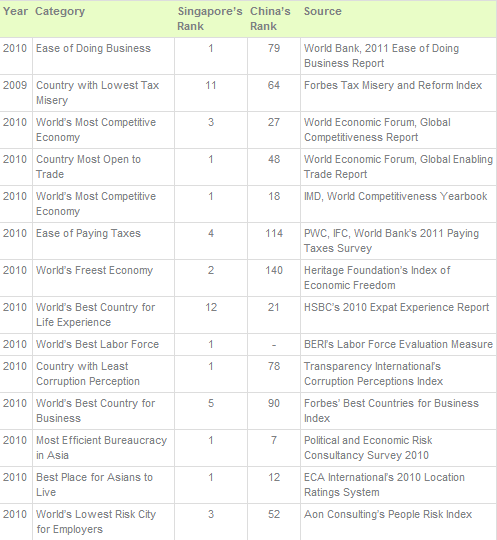
In this article, Kyle Spencer explains why China is enamored with SG's economic and political model, but how the Chinese underestimate the task ahead of them of emulating SG (in part if not in whole, and if this is indeed their intent).

However, the reasons for China's interest in the Singapore Model makes for a compelling argument for Singapore as an investment interest, and Spencer makes this argument well.

Inevitably, there will be conspiracy theorists and Singapore bashers who seem to crawl out of the woodwork and trot out their pet conspiracy theories as to how Singapore succeeded (they need to justify to themselves why their own country is in the shits, despite having more natural resources, despite having more people, despite having more land, despite having history on their side).

Spencer was not interested in defending Singapore or Singapore's model, only his argument that Singapore is a good investment. So in the original article he has this to say:

Extract from:
http://seekingalpha.com/article/785611-why-chinese-officials-are-in-love-with-the-singapore-model

Corruption-Free

To hear the most enthusiastic of the pro-Singapore Chinese bureaucrats tell it, the only significant obstacle to adapting the Singapore Model to China is to stamp out corruption, and success will surely follow.

What the intelligentsia of the CPC fail to grasp is just how corrupt Singapore isn't. Transparency International ranks Singapore as the fifth least corrupt country in the world. By Singaporean standards, Germany, Japan, the United Kingdom, France and the United States are hopelessly and inexcusably corrupt.

China, on the other hand, is the 75th most corrupt nation. That means that China is more corrupt than Italy, about par with Columbia (sic), and only slightly less corrupt than Greece.

That's a long way to climb.

Singapore also offers protection for intellectual property rights, adhering to the WTO's TRIPS Agreement, the Berne Convention for the Protection of Literary and Artistic Works, and the Paris Convention for the Protection of Industrial Property. China is one of the world's most notorious offenders. In addition, Singapore holds the highest e-government ranking in the world.


Spencer's reply to the question in the comments, "Is Singapore a Corruption Haven for the billions of dollars parked there by corrupt Indonesians?" was this:
It's a matter of corruption chasing Singapore rather than Singapore chasing corruption.

"The global financial organization estimates that the amount of assets of Indonesian people in Singapore is S$87 billion, or around Rp506.8 trillion.

According to Teten, embezzlers prefer to deposit their funds in Singapore because they feel safe there although the origin of the funds is illegal.

The reason for this is that Singapore does not have a Money Laundering Law nor is it yet willing to sign an extradition agreement with Indonesia.

Through such an agreement, Indonesia can force Singapore to surrender bad debtors, including return of assets and funds.

Teten acknowledged that Indonesians also save funds in Singapore because of other factors, for example business.

This is because the business and investment climate in Singapore is very attractive.

"In addition, legal certainty is also good, far better compared to in Indonesia," he said."

http://bit.ly/Nz3u33

If you're corrupt, you don't want to park your money in a banana republic, because there's no honor among thieves. You'd want the just the opposite: an affluent, bustling international financial center that doesn't ask foreigners inconvenient questions.

Singapore is the world's fourth leading financial center, but its success as such isn't built on corruption, it's built on Singapore's maritime supremacy and ease of doing business. Singapore is the world's second-biggest casino gambling market, one of the world's top three oil refining centres, the  world's largest oil-rig producer, a major ship-repairer, and a top tourist destination. The port is one of the five busiest ports in the world. Singapore has the world's highest percentage of millionaires, with one out of every six households having at least one million US dollars in disposable wealth. This excludes property, businesses, and luxury goods, which if included would further increase the number of millionaires.

Now, that being said, it's prosperity is linked through its reliance on exports to the broader global market,
specifically America. Historically, Singapore is the first to go down in the event of an acute crisis, but its also the first to recover. See:

http://bloom.bg/Nz3u3b

http://buswk.co/NaQIMq

As always, due diligence is a must.

The article Spencer quoted (and linked) was from Oct 2006. In Dec 2010, SG's Deputy Prime Minister and Defence Minister visited Indonesia and spoke to students of Indonesia's Defence University. One of the question was about the extradition of corrupt officials.

In brief, the answer to the students was:

1) Corrupt Indonesians and corruption in Indonesia are an Indonesian problem to be solved by Indonesia. Singapore solved the corruption issue internally. We did not need extradition of corrupt officials, or money laundering laws to be enacted by other countries. Even if such laws and treaties were in place, without addressing the root cause of corruption, it simply means that the fruits of corruption will be channeled elsewhere.
2) Singapore is willing to help and had in fact agreed to an extradition and defence cooperation treaty. Indonesia's parliament has refused to ratify the treaty.
3) Where the Indonesian Courts have made a finding or judgement as to corruption and the funds involved and made a court order, the Singapore authorities have complied with such court orders.


Monday, August 6, 2012

Iron out flaws in MediShield first

Aug 03, 2012
 
PROPOSED COVERAGE FOR BABIES WITH BIRTH DEFECTS
 
By Salma Khalik Health Correspondent
 

THE birth of a child should be a joyous event. Unfortunately, this is not the case for all.

Between 2 per cent and 3 per cent of babies born each year in Singapore suffer from some congenital problems. Some conditions, such as a cleft palate or a club foot, merely need some initial treatment for the child to lead a completely normal life. Some others, like some congenital heart diseases, might require lifelong care.

The cost, even for a highly subsidised C class patient, can vary from a few hundred dollars to more than $100,000, which most people would find a heavy burden.

Everyone appears to agree that parents of such babies, and the people with such problems, should get help. What they disagree on is who should pay.

Is this something that society as a whole can help out with, should we all share the burden?

Since the subject was raised a few years ago, there have been discussions on whether MediShield, the national health insurance scheme that covers 93 per cent of the population, should cover congenital problems.

Those with a strong social conscience, or with personal or family experience of such problems, are vocal in its support.

Others, worried about the additional cost to them, argue that asking policy-holders to pay for the treatment of a known problem is unfair to the healthy. Instead, they view insurance as essentially pooling risks for potential problems that all are at equal risk of getting.

They argue that it should be the Government's job to look after such unfortunate people.

Given the polarisation of views, the idea of extending insurance coverage for neonatal and congenital diseases is clearly not one that the Health Ministry can push through without strong public support.

There are at least a few other reasons why some are wary.

As is obvious, the need for neonatal care is immediate and congenital problems are usually diagnosed within the first year of birth.

As MediShield is an opt-out scheme, there is nothing to stop parents of healthy babies from signing up at birth, and then opting out after the first year when they realise their baby does not need the coverage.

The Ministry has calculated that if the parents of children aged up to 20 years are fully behind it, then all each has to pay is an additional $12 a year. This means everyone needs to pay a total of $240 more - over a period of 20 years - to help out.

To some, this is part and parcel of being a caring society, to share the burden of paying for treatment for the stricken.

Others may view this as a forced subsidy they are unwilling to bear. Such people might decide to drop out of the scheme after a year or so, once they are confident that their child is not suffering from any congenital diseases.

If the group that drops out is large, it would push up premiums for those remaining on the scheme, which could lead to a domino effect of even fewer people wanting to be on it. Folk who are willing to pay $240 for coverage their family does not need, might baulk at $480, or more.

There is, however, a way out of this dilemma, and that is to load the premiums upfront in the baby's first year, or even better, from before the birth of the child.

That is when parents are still uncertain if their child has such diseases, and when they are likely to be willing to fork out the premiums for peace of mind.

At that point in time, most parents would be willing to pay high premiums of $200 or even more - especially as it can be taken from their Medisave accounts.

This means very little of the cost needs to be spread out among policy-holders up to the age of 20, making it less likely that they would drop out.

But the suggestion to cover neonatal and congenital problems with MediShield has another flaw.

This basic scheme is pegged at subsidised treatment at a public hospital. But more than half the babies born here are delivered in private hospitals.

If the baby is born premature, treatment will have to be at the place where the infant was born. If they are transferred to a public hospital, the child has to be a private patient.

A KK Women's and Children's Hospital spokesman said to downgrade to a subsidised ward, the parents have to be means tested. Is the payout from MediShield enough to pay for private treatment?

If not, it might defeat the purpose - unless the MOH is willing to change the current rule and allow any infant transferred from a private hospital to enjoy subsidised rates.

After several years of discussion, it would be a pity if Singapore is still unable to insure people born with congenital medical problems, or the several thousand born premature each year.


Sunday, August 5, 2012

People drive more when COE prices rise

Aug 02, 2012

ASK: NUS ECONOMISTS
The Sunk Cost Fallacy

  • The COE system has been in place for more than 20 years and yet the roads are still so crowded. Has it really been effective in controlling congestion?

LIKE many other cities, Singapore faces the challenge of managing traffic congestion. Since 1975, the Government has addressed the problem in two ways - pricing road usage and limiting the vehicle population. From 1990, the Government has explicitly limited the number of new car registrations to a monthly quota for Certificates of Entitlement (COEs).

At the last auction, the price of COEs (strictly, the COE quota premium) for large cars reached $90,501. COE prices have not been so high since late 1994. The result has been hand-wringing, howls of complaint and a torrent of letters to The Straits Times.

Quickly moving to assuage public concerns, Minister of Transport Lui Tuck Yew is talking of tweaking the system to moderate the inflation in COE prices. The latest change is to remove taxis from the bidding process for COEs in the small car category. Instead of bidding, taxis will pay the prevailing quota premium, and the quota will come from the Open category which can be used for any size of cars.

Yet, there seems to be little discussion of the more fundamental issue. Just how effective is the COE system in managing traffic congestion?