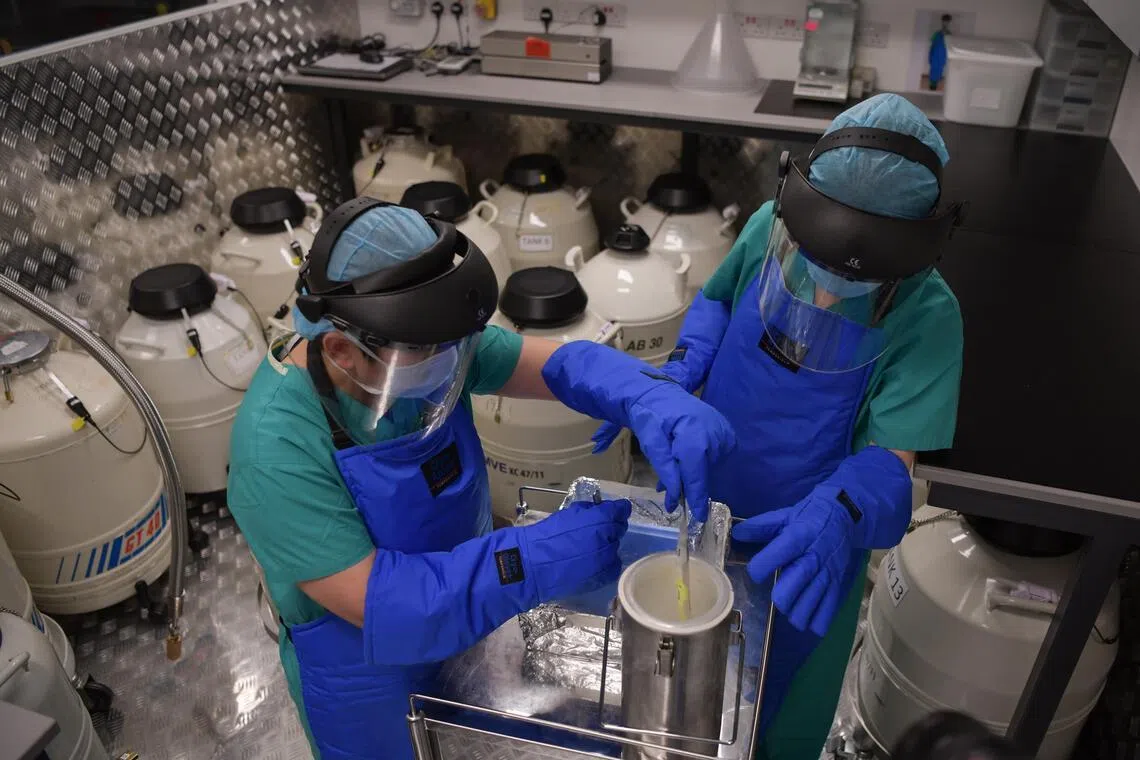
 |
| In Singapore, women aged between 21 and 37 – regardless of their marital status – are allowed to undergo the procedure, which preserves their fertility. |
Summary
- Since Singapore allowed elective egg freezing in June 2023, over 800 women have undergone the procedure by end of December 2025, according to Health Minister Ong Ye Kung.
- 57% of women freezing their eggs are 35 years of age and older, 39% are 30-34, and 4% are under 30. The procedure allows women to preserve fertility as egg quality declines with age.
- Elective egg freezing costs about $10,000 per cycle in public hospitals, is not subsidised, and is available to women aged 21-37.
Singapore – More than 800 women have frozen their eggs for non-medical reasons since elective egg freezing was allowed in Singapore in June 2023.
In a parliamentary reply on Feb 4, Health Minister Ong Ye Kung gave an update of the latest figure as at end-December 2025.
About 57 per cent of these women were aged 35 and older, while 39 per cent were between 30 and 34 years old. Only 4 per cent of the women were under the age of 30.
Mr Ong, who is also the Coordinating Minister for Social Policies, was responding to a question by Non-Constituency MP Eileen Chong.
She asked about the number of women who have gone through the procedure, their age breakdown and the average out-of-pocket cost of the procedure at public hospitals.
In Singapore, women aged between 21 and 37 – regardless of their marital status – are allowed to undergo the procedure, which preserves their fertility. This is because the age of their eggs remains unchanged from the moment they are frozen.
A woman is born with a finite number of eggs, with the number and quality of eggs declining as she ages. As such, the chances of a woman getting pregnant decrease as she ages, doctors say.
Before the landmark move to allow elective egg freezing, women could freeze their eggs only for medical reasons, such as when they have to undergo chemotherapy, which could adversely affect their fertility.
Former minister of state for social and family development Sun Xueling said in 2022 when the move was first announced: “We recognise that there may be women who are not able to find a suitable partner when they are younger, but they still wish to be able to preserve the likelihood of conceiving when they marry later.”
Doctors previously interviewed by The Straits Times said many of the women they see are single or are unsure about having children, which are among the reasons they choose to freeze their eggs.
The procedure is not subsidised by the Government, and is costly.
Mr Ong said that one egg freezing cycle at a public hospital costs about $10,000.
While singles can freeze their eggs, only legally married couples can use their frozen eggs to try for a baby through in-vitro fertilisation.
In a parliamentary reply on Feb 4, Health Minister Ong Ye Kung gave an update of the latest figure as at end-December 2025.
About 57 per cent of these women were aged 35 and older, while 39 per cent were between 30 and 34 years old. Only 4 per cent of the women were under the age of 30.
Mr Ong, who is also the Coordinating Minister for Social Policies, was responding to a question by Non-Constituency MP Eileen Chong.
She asked about the number of women who have gone through the procedure, their age breakdown and the average out-of-pocket cost of the procedure at public hospitals.
In Singapore, women aged between 21 and 37 – regardless of their marital status – are allowed to undergo the procedure, which preserves their fertility. This is because the age of their eggs remains unchanged from the moment they are frozen.
A woman is born with a finite number of eggs, with the number and quality of eggs declining as she ages. As such, the chances of a woman getting pregnant decrease as she ages, doctors say.
Before the landmark move to allow elective egg freezing, women could freeze their eggs only for medical reasons, such as when they have to undergo chemotherapy, which could adversely affect their fertility.
Former minister of state for social and family development Sun Xueling said in 2022 when the move was first announced: “We recognise that there may be women who are not able to find a suitable partner when they are younger, but they still wish to be able to preserve the likelihood of conceiving when they marry later.”
Doctors previously interviewed by The Straits Times said many of the women they see are single or are unsure about having children, which are among the reasons they choose to freeze their eggs.
The procedure is not subsidised by the Government, and is costly.
Mr Ong said that one egg freezing cycle at a public hospital costs about $10,000.
While singles can freeze their eggs, only legally married couples can use their frozen eggs to try for a baby through in-vitro fertilisation.

No comments:
Post a Comment